Get early access to listings that match your criteria
Never miss an opportunity again. Our personalized alerts notify you instantly.

 English$ USD · m²


A 19th-century house with an outbuilding, a gîte, a pond and a garden covering almost 5,000m², tucked away 10 minutes from a town on Normandy’s Cotentin peninsula. You reach the property from the road that runs through the village. It lies on raised ground in this marshy region and enjoys a clear view of the surrounding Norman countryside. The house faces the whole garden and is flanked with its gîte and outbuilding. A pond lies in the middle of the garden. The bottom of the garden is extended with a small footpath. The main edifice was built in the 19th century. It is made of rubble schist. It has a ground floor, a first floor and a second floor in the roof space. It is crowned with a gabled slate roof. An extension was added to the original building in the 2000s.
…By Patrice Besse


The advertiser did not provide an english description for this listing.
…By Patrice Besse


The Villa d'Eaux, an exceptional and significant edifice on the Côte Fleurie, in the centre of Villers-sur-Mer and 100 m from the beach. Villers-sur-Mer is one of the seaside resorts created in the middle of the 19th century and built along the Côte Fleurie between Trouville-sur-Mer and Cabourg, between the Côte de Grâce and the Côte de Nacre. It was a Parisian elite in search of a getaway in a healthy climate that drove the development of seaside tourism on this stretch of the coast. They were attracted by the landscape and picturesque charm of these isolated spots, which had been revealed by painters. Villers-sur-Mer was founded by Félix Pigeory, a Parisian architect, who bought about twenty hectares of land with his private funds. The town first expanded on the heights of the Vaches Noires cliffs with villas built by the Empire aristocracy, followed by the construction on plots of land by the sea, notably with the creation of a casino. It then became a well-known family resort. The first municipal baths and showers opened in 1913. At the time, they comprised sixteen cabins built on two levels, served by two galleries that encircled a patio topped by a glass roof.
…By Patrice Besse


The advertiser did not provide an english description for this listing.
…By Patrice Besse


The advertiser did not provide an english description for this listing.
…By Patrice Besse


An Art Deco former hotel and its tree-filled garden of 4,500 m² along the edge of the spa town of Bagnoles-de-l’Orne. Surrounded by many villas built in the Anglo-Norman style of the 1920-30s, the property, which contains one of the older buildings in the residential neighbourhood, is located on the corner of two quiet streets and partially concealed behind the tall trees of its garden, the latter of which still retains its original outline. Accessible via a private road in the back, the imposing three-storey building overlooks the street and is made up of an immense central structure, flanked by two right-angle wings and pavilions abutting each end. Built over several periods, the edifice nevertheless exhibits a rather homogeneous style with false half-timbering, wrap-around stringcourses and brick arches, dormer windows, wooden guardrails and a slate Mansard roof. In addition, immense windows, a conservatory as well as a number of balconies and terraces enliven its stately exteriors.
…By Patrice Besse


On the edge of Normandy Switzerland and the banks of the Orne, a 18th century manor to restore, its outbuildings and equestrian domain on nearly 4 hectares. 15 minutes on foot from the center of the village, a small departmental road leads to the entrance of the estate, enclosed by a schist wall topped with a wrought iron fence. The gate, flanked by stone pilasters crowned with gendarme hats, opens onto a grassy driveway and an honor courtyard that extends in front of the main living quarters. Two other lateral entrances provide access to the outbuildings. The estate was owned by the Lemarchand des Lingeries family for more than a century, from 1745 to 1877. It consists of a main building constructed in the 18th century, extended by a wing. Nestled in its garden, it rises three levels under the roof and is topped with a pavilion roof of flat tiles in orange hues, where four chimney stacks point towards the sky. The rubble is covered with a coating, and the window frames are made of dressed limestone. The large bays, aligned and stacked, are doubled with cross windows in wood. Two turrets, one round and one square, adorn the courtyard side facade. The facade of the wing, built on one level, is made of worked rubble stone and pointed, with red brick cladding framing the windows. The building is topped with a gable roof of slate. At one corner of the wing, on one side and at the back of the manor, there is an outbuilding consisting of a residence and a wellness area. On the exteriors, on one side extend a caretaker's house, a press, and cellars. Opposite are stables, barns, boxes, garages, and sheds. The whole is surrounded by enclosed meadows for horses. The southeast facade of the house faces a garden with a pond and a washhouse.This description has been automatically translated from French.
…By Patrice Besse


A splendid 19th-century house with a 900m² garden, nestled in the town of Flers, beside a natural area of Normandy nicknamed “Norman Switzerland”. The edifice was built in the 19th century. It has a basement, a ground floor, a first floor and a second floor in the roof space. It is crowned with a hipped mansard roof covered with slate tiles and punctuated with dormers. Two chimney stacks rise up from the roof. Rubble granite and schist with pointing form the elevations. Finely carved granite ashlar forms the many door and window surrounds. On one side of the house, a wrought-iron gate leads to a tree-dotted garden that faces south-west, behind the dwelling. At the bottom of the garden, there is a lean-to shed and a garage. From there, a gate leads out onto a calm, narrow street.
…By Patrice Besse


A large, luxurious home, its outbuildings and almost 5 ha between the Manche and Calvados departments in the Bessin region. The road gives direct access to the entrance courtyard. The 17th century house is directly in front. A large, Napoleon-style stable stands at right angles. Both buildings are surrounded by vast areas, laid to lawn, followed by meadows. The other outbuildings are set out behind the stables.
…By Patrice Besse


A 19th-century house and secondary dwelling, both recently restored, with a 5,000m² garden, only a kilometre from the sea, between Trouville-sur-Mer and Honfleur in Normandy. A double wooden gate among hedge-lined meadows leads from a lane to lawns. A gravel court separates the main house from a large garage and secondary dwelling. Beyond, the garden, lined with hedges, faces west. There are many tall trees. A stream runs through the plot towards the lane.
…By Patrice Besse


A restored, 19th-century manor, in the south of the Manche area, at the crossroads of three regions. A wrought iron gate in a tall stone wall opens from the street into the property, which boasts great architectural and landscaping coherence. The manor was built in the 19th century and stands in the middle of the grounds. Its sober silhouette is marked by an adroit mixture of Art Nouveau and Anglo-Norman styles. The property’s overall balance is reinforced by the immaculate and harmonious interior decorations and fittings. The three-storey façades made of rough-hewn blocks of granite are punctuated by slight protrusions and many tall, small-paned windows through which light streams into the interior. The steep sloping slate roof is dotted with tall stone chimney stacks. Set back from the manor house, the outbuildings avoid impinging on the property’s unity. The grounds are faithful to the original landscaping design and surround the residence with carefully mown lawns, winding paths and a variety of different trees. A vast meadow extends away from the property towards the surrounding countryside beyond the river. The residence was once home to the marine painter Marin-Marie, who was a solo yachtsman and a talented illustrator. He is famous for his daring transatlantic crossings on board the Arielle yacht and for his highly accurate maritime drawings.
…By Patrice Besse


A renovated 19th century farmhouse, wooded garden and meadow in the ancient Houlme region, near Domfront and Flers . A 10-minute walk from the hamlet of Val-Michel with its traditional cob and wood or granite houses, a small, quiet, winding road leads to the entrance to the old farmhouse. A fence with two round wooden rails has a plain gate, which opens onto a courtyard and its lime tree. A green hedge planted with a variety of species follows the shape of the hilly area surrounding the garden. Inside the courtyard are the house and an old cowshed, which faces a barn and an old stable.
…By Patrice Besse


In Normandy, in a village of Cotentin, a master house from 1810, with an outbuilding, a French garden, and a park of 5200 m². Access is through a gate framed by stone pillars and trimmed hedges, which opens onto a gravelled courtyard. At the back, the facade of the house is adorned with lush virgin vine. It overlooks a French garden, whose layout is of great rigor. The tall trees and hedgerows form a vegetative screen, ensuring absolute privacy. Built in 1810, the residence has two levels including the attic. The slate roof is hipped. Perpendicular to the main dwelling and independent, the outbuilding is one level high. Built at the same time, it allows for doubling the living space of the whole and is adjacent to a garage that can accommodate two cars.This description has been automatically translated from French.
…By Patrice Besse


In Orne, in the rolling landscape of Perche, a restored manor listed as a historical monument, protected by high walls, and its garden. Within walking distance of the village, halfway up a hill, at the end of a small road, the estate reveals itself, surrounded by tall walls flanked by round towers. The manor enclosure, accessible via a monumental crenelated gate, encircles a large U-shaped courtyard. The layout has been carefully landscaped, taking advantage of the slope and opening to the west towards the surrounding countryside, overlooking the enclosure. The main building is characterized by its high gable roof, covered in tiles and highlighted by a cornice. It is extended by a second building that is attached to it. Other buildings, respectively used as a gite, guardian's house, and various dependencies, complete the enclosure. Behind the main building, accessible by the layout, an orchard of 2 hectares commands the countryside.This description has been automatically translated from French.
…By Patrice Besse


In the Orne department, on the outskirts of the Norman Switzerland region, a 17th-century farm-manor house, its courtyard and garden of nearly 7,700 m². A long driveway, 300 years old and planted with horse chestnut trees, leads to the 17th-century impregnable-looking seigniorial home, once the estate of the famous marquis d’Ango. A covered double gateway with a basket-handle arch decorated with the coat of arms of the Motte Ango family, as well as an adjacent pedestrian door open onto a grand rectangular courtyard. All around, organised in a U shape, is the central manor and its outbuildings, the tree-filled garden and the chateau’s former moats. Facing the courtyard on the southern side, the 17th-century dwelling has two floors with convertible attic space, crowned with a gabled flat tile ochre roof. It is punctuated with three dormer windows topped with triangular pediments. Its stately façades are made out of hard masonry, granite, limestone, schist, puddingstone, formed from large dressed rubble stone. The windows are aligned in vertical rows, including the dormer windows, inserted into dressed grey granite surrounds.
…By Patrice Besse


A 19th-century manor in around 5 hectares of grounds, 4 kilometres from Luc-sur-Mer and 20 minutes from Caen, in the heart of a lush valley. On the outskirts of a neighbourhood dominated by the bright shades of Caen stone, a lush, green track arrives at a wrought-iron gate. Beyond it, the private drive through the woods leads to a clearing tucked away from prying eyes. On one side, a foliage-covered, chalk cliff provides natural protection, while on the other a wood including hundred-year-old trees envelops the place in a peaceful atmosphere. In the centre, the garden is made up of several lawns, an orchard and grassy meadows spanning approximately 6 hectares. The late 19th-century residence, combining neo-Gothic and Anglo-Norman influences, stands on a slight outcrop. The three-storey main residence boasts a semi-underground garden level, a first floor and a converted attic. Its irregular L-shape gives it a picturesque silhouette. The steeply sloped slate roof combines dual-pitched Mansard, pavilion and conical roofs, punctuated by dormers and brick chimney stacks. The roof ridges are topped with decorative metal caps, sometimes arrow-shaped, underlining the building’s verticality. The façade combines light-coloured rendering with decorative half-timbering, in keeping with Anglo-Norman tradition. Tall mullioned and transom windows, a central oriel window and a wooden balcony punctuate the façade, while a semi-circular wooden patio overlooks the grounds. To the rear, a modern glazed extension, with a teak patio, blends into the edifice’s architecture, creating a subtle transition between old and modern. The grounds also play host to a covered swimming pool, a wooden pavilion and several landscaped paths, which lead from the house to the surrounding countryside, enhancing the manor’s romantic character.
…By Patrice Besse


A historical residence, with an outbuilding and a landscaped garden, in the upper reaches of Deauville, overlooking the town and the sea. The property stands on the slopes of historical Deauville, in the former village of Dosville dating from the 12th century. It can be reached via a slightly winding, wooded road leading up to a discrete gate. From there, a drive lined with Portugal laurels and cypress trees leads to a parking area before reaching the garden tucked away behind a wall of foliage. The former presbytery, whose architecture has evolved over the centuries, stands at the end of the garden, slightly lower down. It was erected in the 12th century and displays remarkable architectural continuity: successive transformations and additions have enhanced its standing without altering its harmony. The main residence is south-facing and has an elongated shape, topped with a gabled roof made of flat tiles, punctuated by hipped dormer windows and tall brick chimney stacks characteristic of old buildings in the Pays d’Auge sector. The walls made of bright, light-yellow rubble stone, pointed with lime, strike a contrast with the old, dark-coloured carved wooden doors. At the right-hand end of the house, there is a glazed veranda with views over Deauville and the sea on one side and the curate’s garden on the other. The left-hand end is made up of the 18th-century chapel that today houses a spacious living room adjacent to the rest of the building. A half-timbered protruding section topped by a triangular gable stands out from the main façade and overhangs a wooden balcony that can be reached via a both picturesque and functional external flight of steps. The blue shutters, climbing plants and flowerbeds soften the stringency of the residence, allowing the edifice to blend into its environment. The property is enclosed and protected by hedges and buildings: to the left, an 18th-century stone outbuilding runs alongside the street, while to the right, another outbuilding separates it from neighbouring houses.
…By Patrice Besse


An 18th-century former hamlet and its breath-taking garden of more than one hectare, on the outskirts of Bagnoles-de-l’Orne, in Normandy’s Orne department. This former hamlet, refurbished and combined into one single property, is accessible via a dirt lane bordered by an apple orchard, while the buildings themselves are organised around an asymmetrical courtyard and include a large main dwelling, composed of several different, seamlessly connected volumes, a second, smaller dwelling, which could be used as a holiday cottage or a guesthouse, a bakehouse and a former pigsty. Facing east-west, the two-storey main dwelling features a pointed stone exterior on its courtyard side, which is, in turn, cadenced by wood-framed windows as well as dormers on its red tile roof. Behind, on the house’s western side, glass double doors open on to a patio festooned with a grapevine as well as a garden planted with trees, providing unobstructed views overlooking a stream, the latter of which is traversable via a small bridge and winds its way through the garden, flowing over small waterfalls and irrigating aquatic vegetation, such as horsetails and reeds. To the north of the courtyard, the bakehouse and pigsty, today converted into annexes with more practical uses, have preserved their original charm with their stone walls and tile roofs, while the independent holiday cottage, facing south, features a lintel etched with the year 1778 and is accessible from one side via a flight of steps blanketed with nasturtiums. Built out of stone, its exteriors, punctuated by windows providing plunging views of the property, are also topped with a flat tile roof. Carpeted with meadows, woods and a meticulously maintained garden, planted with mature trees and flowerbeds, the property also includes a small artificial pond located towards the southern part of the grounds.
…By Patrice Besse


Perched in the hills of the Vire Valley, with 22 hectares of land, a listed chateau from the 13th and 15th centuries. On the outskirts of the city, a long tarmac driveway lined with horse chestnut trees descends towards the property’s entrance. Gradually, the landscape becomes less and less urban and the lawns on either side of the road become more expansive. The road leads to a wrought-iron gate supported by two solid schist rubble columns, extended on either side by low walls topped with fencing. Nearby, a chapel stands on a hill. On one side, the driveway runs along the length of an outbuilding, which is used as a garage, before reaching a square tower. The chateau stands on a promontory, with, as its background, the woods, which blanket the flank of the small valley and fields that border the Vire River. The fortress was built along the edge of a cliff overhanging the river by about twenty metres. Impregnable to the north, it was protected to the south by walls, towers and a drawbridge, which were destroyed in the 19th century. Today, the edifice is composed of the vestiges of an imposing construction and a wing built at a right angle to the body of the main building. Constructed out of schist rubble stone, it was built over three levels, including the attic space. Hipped dormer windows punctuate the slate roof on the side facing the Vire River. To the south, the front entrance is framed by columns, which support a straight lintel and triangular pediment. A three-sided, slightly projecting, tower houses the interior spiral staircase. It is topped with a triangular dormer with an oval oculus. A second round tower with a pepperpot turret roof is attached to a corner of the building. The mullion and cross-window surrounds are in granite ashlar stone. On the exterior corner of the two main buildings, a square extension with a slate hipped roof was built over two stories.
…By Patrice Besse


The advertiser did not provide an english description for this listing.
…By Patrice Besse


The advertiser did not provide an english description for this listing.
…By Patrice Besse

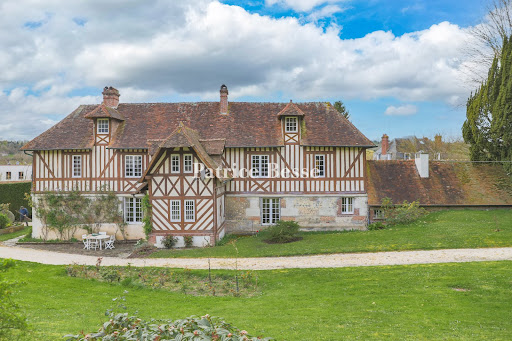


An 18th-century manor with 4,000m² of lush grounds on the Camino de Santiago pilgrims’ way in Normandy’s Calvados department. The manor stands on slopes on the north side of Lisieux, near the River Touques. It is nestled in a lush backdrop. The property’s origins date back to the Middle Ages. It owes its name to a canon who would receive a prebend from the bishop in return for teaching the Holy Scriptures. The extensive plot of land forms a triangle where two calm roads meet. The majestic building is a single edifice that looks out at lush lawns, which extend around a driveway. The driveway leads to the manor and garage. It splits into two separate lanes that run along either side of the manor. A group of tall trees on the north side lies beyond an orchard, a vegetable patch and lawns. A thick thuja hedge encloses the grounds, ensuring absolute privacy. Beyond it, there is a semi-rural environment of green landscape that is dotted with woods and that stretches to the horizon. The manor was built in the 1780s and 1790s when forest-clearing had almost been completed in the region. It is a half-timbered construction with timber framing that is typical of architecture in the Pays d’Auge province. The main section has a ground floor, a first floor and a second floor in the roof space. Oak was used for the building’s framework. Cob filler was used for the spaces between the beams and then lime-rendered. This method was inexpensive during the house’s period of construction. Today, it characterises the identity and charm of traditional Norman homes. The timber framing is mainly in the building’s upper section, its lower section being made of brick and stone. Old tiles cover the hipped roof. A protruding section on the east side that leads out southwards was built in the same style as the rest of the house, probably after the Second World War. Its roof has a jerkinhead end and eaves. The roof also has two dormers that face, at a right angle, two dormers on the roof’s east slope. On the entrance side, there are three other hipped dormers. Two brick chimney stacks rise up from the roof too. All the windows are single-glazed and have small panes. At the end of the house, an additional section adjoins the manor. It has a gable roof of old tiles with a small dormer. This extension forms a garage. It is used as a utility section and was probably originally a farm building to which the manor was added.
…By Patrice Besse


A 19th-century property edged with a river in 7,000m² of grounds, nestled between the towns of Argentan and Falaise in Normandy. A country road leads down through woods and meadows to a private lane that takes you to the dwelling. A large gate opens onto a paved driveway that leads to the watermill. There is a big wooden garage behind it. A millrace made of stone runs alongside one side of the house and harnesses the river water through two oak sluice gates that open to let tree trunks float to the sawmill. A large island lies in the river. Two wooden footbridges lead to it. Behind the house, a terrace with a view of the River Orne lies opposite a timber shed. The watermill is made of local stone. It offers a floor area of around 200m². Its hipped roof of flat tiles is punctuated with hipped dormers and skylights. One section of the roof is raised. A continuous balcony runs along the first floor. Two timber corbels support a canopy above the entrance door. On both sides of the house, a broad stone terrace runs alongside the lawn. A lime-rendered elevation is dotted with large windows fitted with shutters painted blue and French windows that lead out into the garden. This watermill has appeared on maps since 1881. Today, its waterwheel has gone. Before, the mill used the river’s energy to saw wood. The waterwheel was opposite the lounge window. The sluice gates, the machinery of which is still here in place, would be opened so that logs could float along the millrace then be placed on a cart to be sawed. A saw blade, operated by the water’s energy, stretched across the room where the lounge is today.
…By Patrice Besse


A large townhouse to be renovated, from the 16th and 17th centuries, with outhouses divided into apartments, nestled in the town of Falaise in Normandy’s Calvados department. The property stands on a calm street. The old edifice was doubtless an important home at the time of the Catholic League of France – a major participant in the French Wars of Religion. As early as in the 14th century, this part of the town was home to the burghers of Guibray – a district of Falaise. Their land initially belonged to the abbots of the local Abbey of Saint John. Fairs were held here and there were many inns in this district too. The house was probably one of those inns. It is set back from a small square that still bears the name of one of the members of the Catholic League of France in Falaise, from the time of the French Wars of Religion. Nicknamed the Hôtel du Grand Coq, the edifice was later the home of a wealthy parliamentarian. It lies near Notre-Dame de Guibray church and is tucked away on a well-preserved historical street, a short stroll from specialist food shops and amenities. On the street side, the noble edifice has an appearance that is typical of the 16th and 17th centuries. The structure is more wide than tall and is made of Caen stone. On the court side, the building is made up of three dwellings that form a square courtyard, half of which was later linked to the initial dwelling. The edifice’s rear elevation bears witness to the redesigns that have taken place over the course of the centuries: there are corbels, roof slopes and the remains of a tower that was reduced in height and which dates back to at least the 16th century. On the left, a stone elevation is coated with rendering in the modern part. Beyond it, there is a small outhouse with a slate roof and two small-paned windows. Lastly, with its back to the street and leading out through the rear elevation of the main dwelling, there is a former forge that has been converted into a dwelling. It has seven windows. From the court, steps lead to the back of the plot. The property’s walls enclose the whole plot. In the central court, low walls demarcate different small gardens. To the right of main section, on the court side, there is a timber gallery that connects to the different apartments on the first floor.
…By Patrice Besse


A residence undergoing renovation, in an approximately 5-hectare estate, in the south of the Manche area, not far from the centre of the Mortainais sector. This approximately 5-hectare estate can be reached by a small lane that branches off a country road. It assumes the appearance of a well-structured rural property, surrounded by lush, undulating countryside overlooking a small valley through which a stream runs. The estate includes several buildings spread around a courtyard. The main, southwest facing residence, in the process of being renovated, is a vast, two-storey long house with a gabled roof made of recently installed slate tiles. The façade combines exposed stonework and light-coloured rendering, punctuated with rectangular windows, some of which have been recently created. It boasts a number of remarkable architectural elements and part of it probably dates from the 17th-century, according to the date of 1665 engraved on a lintel. To the south of the courtyard, there is a vast brick, stone and half-timbered farm outbuilding, topped with a gabled slate roof. In the centre of a courtyard, a well with a hipped roof stands next to an old tower with a press in it. To the west of the courtyard, there is a recently built farm building, hidden by a mound and a tall lime tree. The residence’s roofs are recent and in excellent condition, underlined by roof decking. The materials used display a desire to preserve the place’s authentic character. Due to a halt in the renovation work in progress, only the masonry, roof frame and roofing have been completed so far. There are no floorboards, concrete bases, joinery or sanitation system as of yet. All the plans were drawn up by a professional.
…By Patrice Besse
'%20stroke='%23DDAA3A'%20stroke-width='1.909'%20stroke-linecap='square'%20stroke-linejoin='bevel'/%3e%3c/svg%3e)
Receive by email any new listing that may match your search criteria
Your criteria :
By validating this form, you accept the general conditions of use of Le Figaro Properties.
These agencies offer a selection of luxury properties vente in Basse-Normandie. Feel free to contact them for personalized assistance.


