The agencies at Avallon
These agencies offer a selection of luxury properties vente at Avallon. Feel free to contact them for personalized assistance.

 English$ USD · m²


A former priory from the 13th century, listed as a historical monument and nestled in the Morvan regional nature park in Burgundy. Saint-Jean-des-Bonshommes priory was a monastery that was part of the Order of Grandmont. It was built at the start of the 13th century where an antique sanctuary once stood. Anséric VI, Seigneur of Montréal, ordered construction of the edifice. The monastery underwent the French Wars of Religion in the 16th century. And in 1772, when Pope Clement XIV disbanded the Order of Grandmont, it was made available to the diocesan archbishop. Following the French Revolution, the monastery was sold as national property in 1791 and became a family property up to 1846 when it was damaged by a fire that destroyed most of the monastic buildings. The church, however, survived this fire. In 1880, it became a source of stones as building material, rather like an open quarry. Moved by this fate, a learned society acquired the edifice in 1905, requested that it be listed as a historical monument and set about restoring the edifice. The remaining church is characteristic of the architectural principles of the Order of Grandmont. It is the most imposing edifice in this monastic complex. It has a plain elevation without a door, a single nave and a closed chancel, beneath a brick barrel vault that stretches to a half-dome above an apse with three windows. The chapel’s elevations are made of different stones. The lower ones, evenly sized, are neatly carved blocks and the upper ones, raw rubble stones, lie where the vault rises up. The apse is ornamented outside with four elegant built-in columns. The remains of the monastic buildings have been preserved, including the cloister arches, the elegant arcades of the chapterhouse and part of the walls of the pantries and refectory. The church has a roof of barrel ties, with conical tiles for the apse, made in a local tile factory.
…By Patrice Besse


In Burgundy, in Tonnerre, on the banks of a canal of the Armançon, stands an elegant 18th-century private mansion listed as a historic monument. Located on the main street of the town of Tonnerre, near the Marguerite de Bourgogne hospices, the mansion opens through an imposing porch with a carriage door operated by a wrought-iron mechanism unchanged since its construction. Formerly the property of the sister of Charles d'Éon de Beaumont, known as the Chevalier d'Éon, ambassador in the service of Louis XV, it consists of two symmetrical pavilions without a central body. The roofs and façades, listed as historic monuments, have been recently restored. While the elevations, rendered and simple, punctuated by bays with flattened or straight arches and small-paned joinery, are markers of the 18th century, the roofs of small regional flat tiles, with three or four slopes and coyaux, along with their stone dormers with lowered arches, are particularly characteristic of local architecture. Finally, the park, dotted with ancient oaks and plane trees, extends to the banks of the canal of the Armançon, offering the absolute calm of nature in the heart of the city.This description has been automatically translated from French.
…By Patrice Besse


An 18th century listed private mansion, wooded parkland, lodges and outbuildings, in the historic centre of a Burgundy town. The private mansion stands in a tree-lined square. A double carriage entrance opens onto a paved passageway covered with an antique carpet. The passageway leads to an inner courtyard, flanked by the two wings of the main dwelling and enclosed by an elegant listed wrought iron gate leading to the parkland. Planted with trees and flowers, it is criss-crossed by well-designed paths lined with stone benches and ancient statues, hidden in the lush vegetation. A stone well backs onto the property, which also boasts a heated swimming pool and two lodges with restored facades. Slightly set back, a timber-framed house and its greenhouse were once the caretaker's lodge.
…By Patrice Besse

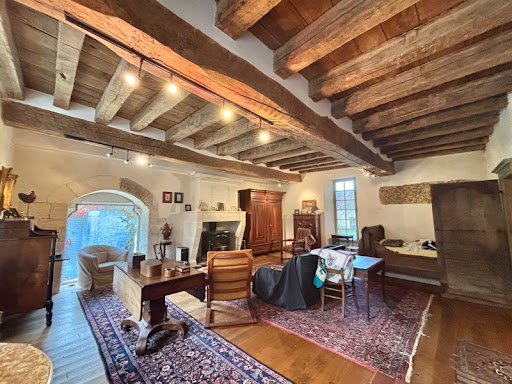


- Listed historical ensemble of rare authenticity, including a chapel, listed as a Historical Monument, the commander's residence and the tithe barn - 7-hectare park with spring and stream, possibility of acquiring additional hectares, outdoor swimming pool - Possibility of numerous projects (prestigious family residence, exceptional secondary residence, or even a hospitality, cultural or event project, enhancing a rare historical heritage, equestrian property or animal boarding, organization of weddings, concerts or cultural and heritage events...) - 1 hour 30 minutes from Paris, 10 minutes from the A77 and Cosne-sur-Loire with SNCF train station, 20 minutes from La Charité-sur-Loire and Sancerre - Significant tax advantages (works on property under the historical monuments scheme) Listed historical ensemble, dating from the second half of the 12th century, in the heart of a preserved estate of more than 7 hectares. Nestled in the heart of a large, wooded park, sheltered from prying eyes and all disturbances, the Commandery of Villemoison is a heritage property of rare authenticity, situated in a verdant valley crossed by a stream and fed by a spring and a Romanesque well. Particularly rare, this complex has retained its three original buildings, characteristic of a Romanesque commandery of the Order of Saint John of Jerusalem, later the Order of Malta: the chapel, listed as a Historic Monument since 1907, the commander's residence, and the tithe barn, whose facades and roofs are also listed as Historic Monuments. Such preservation is exceptional and confers upon the property a historical, architectural, and heritage value of the highest order. The chapel houses a remarkable medieval mural depicting Christ in Majesty in its apse. Two splendid Renaissance dormer windows in the east façade of the Commander's House, adorned with the sculpted coat of arms of Claude d'Ancienville, cupbearer to Francis I and Commander of Malta at Villemoison around 1530, attest to the estate's historical significance. The house is complemented by an elegant 16th-century stone stair tower and extended by a former farmhouse dating from the early 18th century, offering approximately 400 square meters of living space. Carefully restored, the property now comprises nine main rooms, including five bedrooms, two bathrooms, and two shower rooms. It successfully combines the charm of period architecture with contemporary comfort. The grounds also include an outdoor swimming pool, several outbuildings, and extensive grounds. The tithe barn, with a footprint of approximately 100 square meters beneath a remarkable old timber frame, presents particularly interesting volumes and offers significant potential for development. The chapel, which remains consecrated, also offers the possibility of hosting weddings, concerts, or cultural and heritage events, in accordance with applicable regulations. This property would be equally suitable as a prestigious family residence, an exceptional second home, or a cultural or event-based hospitality project that showcases a rare historical heritage. As a listed Historic Monument, the estate may, subject to current legal provisions and administrative authorizations, qualify for tax benefits on certain works, as well as subsidies or support from the DRAC (Regional Directorate of Cultural Affairs) for conservation and restoration projects. Les honoraires d'agence sont à la charge de l'acquéreur, soit 2,92% TTC du prix hors honoraires. Les informations sur les risques auxquels ce bien est exposé sont disponibles sur le site Géorisques : www. georisques. gouv. fr. ** ENGLISH SPEAKERS: please note that Capifrance has an international department that can help with translations. To see our range of 20,000 properties for sale in France, please visit our Capifrance website directly. We look forward to finding your dream home!
…By Capifrance - Aude Kaluzny


Rare historic estate of exceptional authenticity, comprising a chapel listed as a Historic Monument since 1907, the Commander's residence, and a tithe barn, both registered on the supplementary inventory of Historic Monuments 7-hectare park with spring and stream, with the possibility to acquire additional land, outdoor swimming pool Suitable for a wide range of projects (prestigious private residence, exceptional secondary home, hospitality, cultural or event venue showcasing rare heritage, equestrian property or animal facilities, weddings, concerts, cultural events, etc.) 1h30 from Paris, 10 minutes from the A77 motorway and Cosne-sur-Loire with SNCF train station, 20 minutes from La Charité-sur-Loire and Sancerre Significant tax advantages (works eligible under the Historic Monuments scheme) A listed historic estate dating from the second half of the 12th century, set within a preserved domain of over 7 hectares. Nestled in the heart of a vast wooded park, entirely private and free from any disturbance, the Commanderie de Villemoison is a heritage property of remarkable authenticity. It lies within a verdant valley crossed by a stream, supplied by a natural spring and a Roman well sealed with lead. Exceptionally rare, the estate has preserved its three original buildings, characteristic of a Romanesque commandery of the Order of Saint John of Jerusalem, later the Order of Malta: the chapel (listed as a Historic Monument since 1907), the Commander's residence, and the tithe barn—formerly the refectory and dormitory of the monk-soldiers—whose façades and roofs are listed. Such preservation is outstanding and endows the property with exceptional historical, architectural, and heritage value. The chapel houses a remarkable medieval wall painting depicting Christ in Majesty in the apse, recently restored with the support of the DRAC (Regional Directorate of Cultural Affairs). Two magnificent Renaissance dormer windows on the eastern façade of the Commander's residence, adorned with the carved coat of arms of Claude d’Ancienville—cupbearer to King Francis I and Commander of Malta at Villemoison around 1530—attest to the estate’s historical significance and evolution over the centuries. The residence is complemented by an elegant 16th-century stone stair tower and extended by a former farmhouse dating from the early 18th century, offering approximately 400 sqm of living space. Carefully restored, the property now comprises nine principal rooms, including five bedrooms, two bathrooms, and two shower rooms. It successfully combines the charm of period architecture with modern comfort, allowing immediate occupancy. The attic, notable for its superb inverted ship-hull timber frame, as well as the room at the top of the tower, offer significant conversion potential. The grounds also feature an outdoor swimming pool, several outbuildings, and extensive land. A meadow of approximately two hectares, with the option to acquire additional acreage, offers numerous possibilities, particularly for equestrian use or animal facilities. The tithe barn, with a footprint of approximately 100 sqm beneath an impressive historic timber frame, offers striking volumes and considerable development potential. The chapel, still consecrated, also allows for the organisation of weddings, concerts, or cultural and heritage events, subject to applicable regulations. This property is ideally suited as a prestigious family residence, an exceptional second home, or a hospitality, cultural, or event-driven project highlighting rare historic heritage. The property is located just 6 kilometres from Cosne-sur-Loire, offering all shops and services. The A77 motorway is accessible at the same distance, providing access to the outskirts of Paris in approximately 1 hour and 30 minutes. Cosne-sur-Loire train station offers regular connections to Paris-Bercy in around two hours. As a protected Historic Monument, the estate may, subject to current legislation and administrative approvals, qualify for tax advantages on certain works, as well as grants or support from the DRAC for conservation and restoration projects. Heritage authorities are particularly attentive to the continued enhancement of the Commanderie de Villemoison. Conventual complexes that have preserved their medieval layout, original buildings, and such an unspoiled natural setting have become exceedingly rare. The Commanderie de Villemoison therefore represents a unique opportunity to acquire an exceptional heritage property spanning nearly nine centuries of history. As a property protected under the Historic Monuments Act, the estate may, subject to applicable legal provisions and administrative approvals, qualify for tax benefits on certain types of work, as well as grants or assistance from the DRAC for conservation and restoration projects. The seller is responsible for the fees. Asking price (agency fees included): €1,235,000 Agency fees payable by the buyer: €35,000 Net seller price: €1,200,000 Energy rating: N/A Climate rating: N/A Information on potential risks to which this property is exposed is available on the Géorisques website: www.georisques.gouv.fr
…By Agence Mercure Centre-loire
'%20stroke='%23DDAA3A'%20stroke-width='1.909'%20stroke-linecap='square'%20stroke-linejoin='bevel'/%3e%3c/svg%3e)
Receive by email any new listing that may match your search criteria
Your criteria :
By validating this form, you accept the general conditions of use of Le Figaro Properties.
These agencies offer a selection of luxury properties vente at Avallon. Feel free to contact them for personalized assistance.


