Get early access to listings that match your criteria
Never miss an opportunity again. Our personalized alerts notify you instantly.

 English$ USD · m²


Located in the heart of the village of Morancé, this exceptional residence harmoniously blends heritage, elegance and the art of living. It is ideal for connoisseurs of unique properties seeking a home steeped in history. Offering 350 sqm of living space, this residence, dating from 1574 and built by an Italian architect, captivates from the very first moment with the grandeur of its architecture and the authenticity of its heritage features. Upon entering, a staircase adorned with Tuscan half-columns stands out as the property’s architectural signature, preserved with remarkable care over the centuries. Tucked away from view, the property features, across 3,187 sqm of land, a collection of outbuildings that form an integral part of its identity. La Jacobine, the original bread oven, the vaulted cellar and the various outbuildings tell the story of the estate whilst offering numerous possibilities for development. This is a rare layout, ideal for a family home as well as for a reception venue or a prestigious guesthouse. The interior of this manor house exudes timeless elegance: its spacious rooms, high ceilings and the property’s well-preserved character combine to create a unique atmosphere, where the charm of the past comes across naturally. On the ground floor, two spacious living areas complement one another: an elegant reception room, enhanced by a remarkable period fireplace, a French-style ceiling and an Italian-inspired mural depicting trompe-l’œil columns; and a family kitchen where the stone sink and original fireplace also bear witness to the property’s history. The kitchen opens onto the terrace and the landscaped grounds, inviting you to make the most of this unspoilt setting. Each of the two upper floors features two spacious bedrooms with remarkable proportions, offering plenty of scope for various interior design projects. The shower rooms and bathroom are situated within the fortress, continuing the architectural authenticity that has characterised this residence for over four centuries. Rare for its history and remarkable for its authenticity, this manor house offers more than just a place to live: it presents the opportunity to become the caretaker of an exceptional heritage, in the heart of a sought-after village in the Pierres Dorées region.
…By Lyon - Sotheby's International Realty


Barnes Properties and Castles offers you the opportunity to acquire this beautiful Poitevin master house in Vienne (86), near Lencloître, along with its two independent houses, an indoor swimming pool, and its 5-hectare grounds.A harmonious and quality ensemble that has undergone a restoration in accordance with heritage preservation standards by the Fondation du Patrimoine.The buildings are arranged around a large gravely and flowered courtyard accessed through a wrought iron gate.The main house, typically Poitevin, features approximately 180 m² of living space over two levels. It is topped with an ancient flat tile roof and has lime-coated facades. The cornerstones, cornices, and window frames are made of limestone.The two independent houses of 75 m² and 140 m² (previously operated as class 4 guesthouses until 2022, license to be renewed) ideally expand the living area and are sold fully furnished and equipped.Several other outbuildings complement this charming ensemble, including garages, a covered area, a 36 m² room, and a magnificent barn converted into a heated indoor swimming pool.The land extends over a little more than 5 hectares encompassing a courtyard, park, and farmland.All amenities in Lencloître (5 min). TGV station in Châtellerault (25 min).Property in very good condition. No work needed. Ideal for accommodation activities.Energy class: D - Climate class: D / Estimated annual energy costs for standard use: €2202 - €2978 (reference year for energy prices used for the estimate: 2021)Well presented by Jan Erik ALDERLIESTE +33665591211Detailed file available upon request.Information on the risks to which this property is exposed is available on the Géorisques website: www.georisques.gouv.frThis description has been automatically translated from French.
…By Barnes Proprietes & Chateaux


Discover this charming Manoir 20 km from Royan, an exceptional property for which I immediately fell in love, nestled in the authentic village of Nieulle at the heart of the Marais de la Seudre. This character manor combines old-world charm, generous volumes, and exceptional potential for all your projects. The main manor house includes 6 bedrooms, 2 spacious living rooms (one measuring 43 m²), 1 dining room of 31 m², 1 French billiards room of 35 m², and an equipped kitchen. A entire wing of the manor offers a 50 m² room ideal for hosting, organizing meetings, creating a wellness space, or developing a professional project. Another wing of more than 150 m² accommodates 3 additional bedrooms with living areas. The estate is complemented by an independent 3-bedroom guesthouse for friends, several reception rooms, a large 59 m² barn, a 35 m² workshop, a 32 m² cellar, a garage for 4 vehicles, and covered shelters. In total, more than 550 m² of livable space spread across several building structures. The enclosed 5,153 m² grounds offer a remarkable green setting: 10×5 m chlorine pool, magnificent landscaped garden, bamboo grove, vegetable garden, orchard, and a well that can supply the entire house and pool. Located at the heart of the Brouage–Oléron–Royan triangle, just 25 minutes from the beaches of Royan and Île d'Oléron, this estate supports various uses: vacation rentals (gîtes), guest rooms, family or professional events, or a prestigious family residence. A rare haven of peace in a preserved natural setting. This property truly touched me with its authenticity and infinite possibilities.
…By Maxwell-baynes Christie's International Real Estate - La Rochelle - Île De Ré


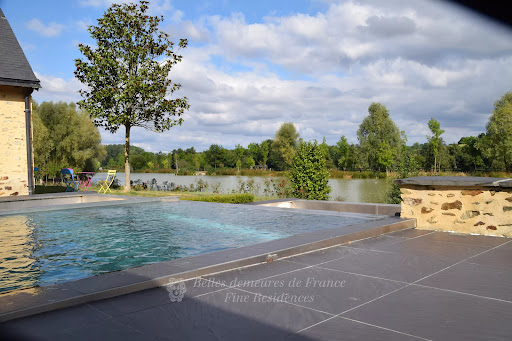

This elegant and meticulously restored near 480 sqm property is in a peaceful location 30 minutes south of Laval and 5 km from a delightful town with all amenities. Dating from the 17th century and subsequently extended, it includes a living/reception room and dining room featuring a monumental fireplace, an equipped kitchen, 8 bedrooms, and 7 bath or shower rooms. A magnificent 95 sqm living room commands a beautiful view of the gardens and accesses a superb terrace and swimming pool. An adjacent stone-built annex with a similar architectural style comprises a 3-car garage, the pool’s heating system and storage space. The near 25 hectares of grounds include 6 hectares of woodland, 12 hectares of enclosed meadows, and 4 lakes (4 hectares approx.) The delightful gardens directly access a navigable river, and feature a 12 x 4 metre swimming pool. With two horse boxes, a saddle room, a manège, and a 400 sqm warehouse. Great potential for a tourist-based activity.
…By Belles Demeures De France Chateaux


Just a stone's throw from Place Brugmann, on one of the most sought-after avenues in Ixelles, this elegant mansion charms with its 7-metre-high Louis XV façade, south-facing French garden and exceptional rear setting.Completely renovated with taste and high-quality materials, it offers approximately 450 m² of living space, complemented by 130 m² of basement space. It features charming reception rooms with refined décor, five bedrooms, including a large master suite, and three bathrooms.A permit for a lift is available, as well as parking space at the front.A rare property combining historic character, contemporary functionality and an exceptional location in the heart of a sought-after neighbourhood. EPC E-
…By Immobilière Le Lion


An exceptional art of living, where history meets elegance Sheltered from view, in the heart of an unspoiled natural setting between Touraine and Berry, lies a rare estate where time seems to stand still. Beyond a majestic stone archway, this characterful property unfolds across nearly 10 hectares of wooded parkland, enhanced by flowering gardens, a tranquil pond, and refined pathways. The manor, with its light-filled tuffeau stone façades, embodies the understated elegance of historic residences. Alongside it, a 15th-century chapel listed as a Historic Monument, a medieval turret, and several outbuildings form a harmonious architectural ensemble rich in history. Inside, generous volumes and noble materials come together: period fireplaces, exposed beams, terracotta tiles, and carved woodwork create a warm and authentic atmosphere. Designed for entertaining, the estate offers multiple living spaces, independent guesthouses, and reception rooms, opening the door to a wide range of projects, whether private or event-based. Blending timeless charm with remarkable potential, this unique property invites you to enjoy a serene, elegant, and inspired lifestyle, just 2H40 from Paris.
…By Terres & Demeures De France


Sole Agent. 50-page detailed file on request. This remarkable early 16th century property bathed in history is located just next to Bazincourt-sur-Epte village and just a few minutes from Gisors in the heart of the Vexin Normand area. Remodelled in the 18th century to fit larger windows, the rectangular main house is brick-built and features a steeply sloping roof, both typical to the region. Recently renovated throughout, it offers about 470 sqm of living space in perfect condition including five bedrooms and five bathrooms. The ensemble also comprises a courtyard with former farm buildings offering a further 830 sqm of floor space with great potential to create an events or tourist-based activity. With a swimming pool. In a prime location in the heart of the delightful Vexin Normand region, near Gisors and the amenities, and with easy access to Paris and the Epte Valley, dear to the Impressionists.
…By Belles Demeures De France Chateaux


Ref 4910: Manor house suitable for events, for sale, 5 km from Falaise On the lands of William the Conqueror, two leagues from the ‘Swiss Normandy’ region, at the gateway to the Duchy of Normandy, an imposing manor farm has stood for nearly three centuries – the last remaining vestige of an exceptional estate, a victim of the ravages of history… But as you round a bend on a country road, history comes into view, concealed by a curtain of trees, inviting curiosity to explore a decidedly discreet entrance, behind which awaits a surprising building of stately proportions. Beautifully situated at the heart of a protected landscape harmoniously shaped by woodland and meadows, the property stands out as an obvious source of inspiration, offering a sense of well-being and freedom. Daily shopping needs are catered for locally, perfectly complemented by the town of Falaise, which, within cycling distance, offers all the services and shops necessary for everyday life. The road links are excellent and provide swift access to rail, motorway, air and sea transport networks. Designed for hosting events, yet with the potential for a wide range of activities, this property will fulfil even the most ambitious projects, supported by the natural richness of its enchanting setting, which is ready for immediate use. Such is Normandy… beautiful, mysterious, a place for a brief visit or a holiday… which often turns into a lifelong project. The property comprises a main house built of rendered stone over three storeys and topped with a hipped slate roof. Adjoining its north-eastern side is a series of outbuildings, one of which is set at right angles, evoking the atmosphere of a main courtyard. Unlike the manor house, these buildings are smaller in scale, and some are roofed with flat tiles. The ensemble is harmonious and balanced, displaying perfect symmetry, a legacy of the Age of Enlightenment. The south-east façade is enhanced by an H-shaped veranda projection, opening onto a spacious terrace leading to the grounds. Set slightly higher up is a luxurious swimming pool, elegantly integrated into the surroundings by a balustrade safety railing. A nearby stone building serves as a pool house (housing heat pumps). Set apart from the main complex, a beautiful stone barn with a tiled ‘cathedral’ roof houses a two-part storage area reserved for farm equipment. A row of small outbuildings follows on from this, revealing various agricultural sheds (chicken coop, woodshed, storeroom, etc.). At the southern end of the manor stands a small stone building with a tiled roof, resembling a sheepfold. A large car park (70 spaces), discreetly situated behind the main courtyard, provides easy access to the manor house and its outbuildings. Set apart from the estate, and perfectly situated for its surveillance role, a ‘stylish’ outbuilding – formerly the bakery of the original château – makes an ideal caretaker’s house, with its own separate and discreet entrances. The property as a whole has been perfectly restored for use as an events venue, yet its immense potential leaves the door open for even the most ambitious projects. I - THE MANOR HOUSE The main feature, exuding prestige and setting the tone. On the ground floor: spacious main entrance hall, with direct access to a pleasant south-facing lounge. Toilet facilities. Hallway and reception area for customers. Kitchen / Utility room. Large reception lounge (mezzanine), with adjoining toilet facilities and commercial kitchen. On the first floor: a stone spiral staircase leading to a corridor serving six bedrooms, each with an en-suite shower room and WC. On the second floor: access via the spiral staircase to three fully fitted and furnished bedrooms. II - THE RECEPTION HALL Reception hall known as the ‘Four Seasons Room’, built on the site of the former cart shed. A 300 sqm hall capable of accommodating at least 150 seated guests and 200 for a cocktail reception. Two annexes, including a dance hall (64 sqm) and a large conservatory (80 sqm) overlooking the grounds, allow for increased capacity. Adjoining cloakroom and toilet facilities. PNR status. The reception rooms feature underfloor heating. Adjoining professional catering kitchen (4 fridges, cold store, ovens). OUTBUILDINGS 1 - Self-catering flats Situated as an extension of the reception rooms, On the ground floor: offices and an adjoining barn used for storing equipment. Upstairs: a straight staircase leading to a corridor serving two dormitories and a large bathroom with a shower and toilets. 2 - A storage barn 3 - Various outbuildings used for agricultural purposes (chicken coop, woodshed, storage shed, etc.) 4 - A caretaker’s house It is situated below the main property, set back from the two entrances leading to the car parks. A very charming 18th-century stone cottage with a rendered façade and a hipped roof covered in small tiles. Formerly the estate’s bakery, it has been completely renovated and now sleeps seven. Ground floor: tiled living room with exposed beams and a converted old bread oven (wood-burning stove). Fitted kitchen area. WC. Upstairs: 2 bedrooms / bathroom with shower – WC. Electric heating and wood-burning stove. Double glazing. Private sewage system. Terrace and flower garden. Wooded surroundings, close to a pond fed by a stream running along the edge of the park (‘Le Val’). The property is full of charm and perfectly functional. THE GROUNDS The property enjoys a commanding position over a single, unbroken 22-hectare (54-acre) park, free from easements and with no neighbours directly opposite. Meadows and woodland each occupy half the space, offering the eye sweeping views into the distance, all the way to the wooded edges. It is here that the more adventurous will marvel at an exceptional ice house, the size of which speaks volumes about the importance of the original estate. Roe deer and hares may occasionally give themselves away… Beautiful pastures, set apart from the lawns reserved for visitors, could easily accommodate a few horses; in their absence, these meadows serve as an additional car park. The old latrines have been preserved opposite the south gable. The swimming pool is the centre of attention, so much is it appreciated. Facing south-east at a reasonable distance from the reception areas, it was built in 2012 as much out of necessity as for pleasure. From a safety perspective, it provides a water supply that complies with current legal requirements for premises open to the public. It also offers a high-quality experience for guests. It features two pools, one of which is for children; the main pool measures 20 x 10 metres, with a depth ranging from 80 cm to over 2 metres. The entire facility is heated by two heat pumps (15 years old). It is surrounded by sturdy balustrades, and access is highly secure. A pool house is attached to it. The plot is situated within the boundaries of the protected natural areas of Lower Normandy. Cabinet LE NAIL - Lower-Normandy - Mr Eric DOSSEUR : +33 (0)2.43.98.20.20 Eric DOSSEUR, Individual company, registered in the Special Register of Commercial Agents, under the number 409 867 512 . We invite you to visit our website Cabinet Le Nail to browse our latest listings or learn more about this property.
…By Cabinet Le Nail


Just a few minutes from the beaches of Locquirec in the municipality of Guimaëc, discover a rare place, steeped in nearly five centuries of history.Mentioned as early as 1543 during the reform of the fouages listing the families and noble houses of Guimaëc, this remarkable Trégor manor, listed in the Supplementary Inventory of Historical Monuments since 1998, will charm lovers of heritage, ancient architecture, and unique places.The main house, dating back to the 16th century, has preserved all the authenticity that characterizes the charm of old Breton homes. Over the centuries, the property has undergone several changes, including the addition in the 19th century of an apoteiz, this architectural advancement typical of Breton constructions, reflecting the various transformations that the residence has experienced over time.Surrounding the manor are the emblematic elements of a true lordly estate: an old stable, outbuildings with a bread oven, a functional well, a garden, and a terrace. Although the enclosing walls and porch have largely been dismantled over time, their main remnants are still present on the property, allowing one to read the original organization of this historically rich place even today.The entire estate sits in an exceptional environment of over one hectare. About 2,300 m² of garden directly surround the buildings, extended by nearly a hectare of woods composed of numerous species, representing nearly a thousand trees. Overlooking the valley of the Lapic River, accessible by a path leading solely to the property, the estate offers a peaceful, intimate, and deeply bucolic setting.Two outbuildings complete the property, as well as an old kennel adapted from the remains of a former stable.This residence is primarily aimed at enthusiasts of beautiful stones and ancient heritage. Having traversed the centuries while maintaining its authenticity, it now offers a rare opportunity for an enthusiast wishing to continue its history and restore it to its former glory, respecting its materials, architecture, and soul.This restoration project will reveal the full potential of this exceptional property and preserve a true witness to Breton history for future generations.More than just a house, it is a true piece of the history of Brittany that is offered to you, just a few minutes from the shops of Guimaëc, Lanmeur, and the beaches of Locquirec.For any additional information or to arrange a visit, contact us now. Agency reference: 7537This description has been automatically translated from French.
…By Orpi - Agence Le Vot


A stately residence, dating back to the 12th century, in 2.6 ha of parklands on the outskirts of a village in the Anjou region. The access road, bordered on one side by poplar trees, goes alongside the parklands and leads to a first set of entrance gates which open into a garage courtyard, within which is a second set of gates. The latter provides access to the caretaker’s cottage, the manor house and the outbuildings. The various buildings, standing in the middle of more than 2.6 ha parklands, are set out around a garden, featuring boxwood and lawn and facing the manor house.
…By Patrice Besse


At the edge of PERCHE, a regional natural park, in Orne, about 145 km west of PARIS, in the MORTAGNE AU PERCHE (61400) - L'AIGLE (61300) area, on a large wooded plot of 9,990 m2, a beautiful CHARACTER PROPERTY including a splendid 18th-century MANSION to restore, containing on the ground floor: entrance with wooden stairs, a dining room, a kitchen, a large living room with a fireplace, hallway, toilet, and boiler room. On the first floor: landing leading to a large bedroom with a beautiful fireplace, dressing room, bathroom and toilet, a second bedroom, another bathroom and toilet, and a third bedroom to restore. On the second floor: a large and high convertible attic under exposed framework. Central heating with fuel. Approximately 180 m2 of living space. An ANNEX HOUSE containing on the ground floor: living room-kitchen, hallway, toilet, two bedrooms, shower room and toilet. Central heating with fuel. Approximately 60 m2 of living space. Attached garage and tool shed. Water tanks. Adjacent land of 9,990 m2 mostly comprising wooded meadow, lawn, and orchard, largely surrounded by hedges. Renovation required. Price: 318,000This description has been automatically translated from French.
…By Eric Leys - Depuis 1974


A restored manor house, outbuilding and 2 hectares of grounds, in a village by the sea on the Cotentin peninsula. In a hamlet a few hundred metres from the village centre, a small road runs alongside the low hedge of the property’s garden. In the distance, a turret topped with a slate roof stands guard over a white wooden gate. Once you’ve crossed it, a gravel path runs alongside a low bench-like wall topped with railings. After a second gate, the driveway leads to the main house and an inner courtyard. The house, built of exposed white stone, is two storeys’ high with an attic, topped by a recently renovated slate roof and crowned with tall chimneys. The facades have straight shaped, evenly spaced windows, with restored white wooden shutters. A pediment adorned with scrolls and Renaissance heraldic figures has a window decorated with an accolade and a coat of arms. The oldest part comprises the remains of a chapel belonging to a 12th-century presbytery. On the ground floor, the house has an entrance hall, a kitchen and utility rooms, a dining room, two living rooms, a bedroom and a shower room. On the first floor there is a master bedroom, four further bedrooms, a shared shower room, a toilet and a bathroom; and in the attic, a loft and two uninsulated rooms. The main building has been extended with a number of more recent additions. At the back, a space featuring large windows is topped by stone balusters. A wing set back from the main building and outbuildings enclose the inner courtyard. These buildings house a garage, a workshop and storage areas, whilst the upper floor is divided into two flats and a spacious communal lounge. It has a slate roof. Beyond the courtyard, the grounds are vast and enclosed, covering 2 hectares comprising pastures, gardens and extensive lawns bordered by various species of tall trees planted in the 1950s. Around the house, the lawns, the vegetable patch and the flowerbeds form an ornamental garden that gradually opens out onto the surrounding landscape.
…By Patrice Besse


A fully restored 16th- and 17th-century manor house in Trégor, about 20 minutes from the nearest beaches. The manor house was built in the heart of peaceful wooded countryside. It served both as a stately home and as the centre of a farm. The noble family who owned it enjoyed privileges within the parish church, as well as the right to exercise high, middle and low justice, symbolised by a sinister three-pillar gallows. Access to the property is via a local track which starts on a quiet country road, before continuing along a private track closed off by a metal gate. From the entrance, the manor house comes into view in the distance, set amongst tall trees. Facing east-west, it is flanked by three stone outbuildings, comprising a farmhouse, a barn adjoining two horse stalls and a feed store, arranged around a courtyard. The property is surrounded by land with an orchard and meadows. The buildings are constructed of rubble stone and dressed granite blocks, with slate roofs. The manor house, which has recently been restored, appears to be the result of two separate construction phases: the northern part is thought to date back to the 16th century, whilst the southern part is believed to have been built in 1665. The main building, which is a rectangular shape, rises over three storeys beneath a roof featuring two tall chimney stacks situated at each end of the gables. The main facade has a dormer window with a pediment, surmounted by a semi-circular gable softened by counter-curves. It also features several remarkable architectural elements, including a semi-circular archway and two bull’s-eye windows. The lintel of a window bears the date 1665 and the monogram IHS (Iesus Hominum Salvator, 'Jesus, saviour of men'), surmounted by a cross. At the back, a square tower topped with a hipped roof houses a granite spiral staircase leading to the upper floors. Finally, a chapel/well faces the manor house.
…By Patrice Besse


B&V Real Estate Heritage is proud to present for sale an exceptional country estate just outside Paris. At the heart of the property stands a remarkable manor whose origins date back to the 16th century, distinguished by Cistercian-inspired architecture and elegantly enhanced in the 19th century by a refined gentleman's residence. Its stone façades, mullioned windows and monumental fireplaces bear witness to the utmost care devoted to its preservation over the centuries. Generous in scale and filled with natural light, the interiors are perfectly suited both to refined family living and elegant entertaining. The estate is further enriched by several other outstanding buildings: A former neo-Gothic mill from the early 20th century, thoughtfully transformed into a charming secondary manor, adds a singular dimension to this unique ensemble and which offers all the qualities of a guest house. A separate guest or staff house offering a variety of conversion and layout possibilities, in particular an ideal configuration for a caretaker's house. Set within 16 hectares of beautifully wooded parkland, the property offers a range of prestigious amenities, including a heated swimming pool with jacuzzi, a treehouse nestled among the trees, four garages, a fitness room, and a generator providing complete autonomy. The estate buildings underwent a complete renovation approximately ten years ago and all the openings of the manor being fitted with double glazing. A true haven of peace, located in the commune of Mériel, just 30 km from Charles de Gaulle Airport and within close proximity to the L'Isle-Adam state forest, this rare property combines the elegance of a Renaissance manor with the serenity of country life. For further information, please do not hesitate to contact us. 2,400,000 € Agency fees not included - Agency commission: 4.17%VAT included Agency fees payable by buyer - Montant estimé des dépenses annuelles d'énergie pour un usage standard, établi à partir des prix de l'énergie de l'année 2021 : 15390€ ~ 20830€
…By Immobilier Patrimoine B & V


This handsome, beautifully presented property is set in its magnificent park of 6 hectares, on the edge of one of the best preserved historic towns in the central Loire valley. The estate includes a handsome main house, built in 1860. 750 m² is usable space 400 m² have already been fully renovated. On the ground floor is a large and spacious hallway, a large sitting room, dining room and a kitchen. Upstairs are 5 beautiful bedrooms and bathroom over two floors. The renovation is recent and features fine parquet floors, large windows with views over the greenery of the park, and high ceilings. The outbuildings are charming and feature two independent studio apartments, an office/orangery and a wellness area complete with a hammam, relaxation room, and shower. In the grounds are also a very fine 14 x 6 metre swimming pool equipped with a BOSE sound system, a wooden treehouse for children, traditional washhouses, an automatic gated entrance with camera and alarm system, and an integrated irrigation system, all within the fully enclosed park.Two enclosed garages and a large open barn house vehicles and equipment. Ideally located, the property is just a short walk from local shops, schools, and the vibrant market in Richelieu. The surrounding area offers a wide range of family-friendly activities, including treetop adventure parks, an equestrian centre and scenic walking trails. Situated near the renowned Loire Valley châteaux, the Futuroscope theme park, and celebrated vineyards, this property provides an outstanding lifestyle in one of the region’s most desirable settings. The property holds an energy rating of D, central heating by water/water heat pump and benefits from an annual property tax of €2,350. As an additional opportunity, a fully renovated 325 m² commercial space in the heart of Richelieu is available for purchase, making it ideal for a professional or entrepreneurial project.
…By Maxwell-baynes Residential And Vineyards - Christie's International Real Estate


The "Henri IV Manor," formerly a post relay, partially renovated, is able to host the public for the following activities: catering (License IV), accommodations, cultural events, weddings, and concerts. All major work has been carried out by highly skilled local craftsmen (only noble materials) to respect the soul of this historic residence. This 700 m² manor is currently divided into three distinct areas: - A private residence of 93 m² under the Carrez law over 2 floors: the ground floor consists of a living room (40 m²) and a kitchen, while the first floor (55 m², of which 41 m² is Carrez law) includes a bedroom, a bathroom, and toilets. Attic space is convertible. - A space of 530 m² to welcome the public, organized as follows: An entrance hall opening onto the ground floor with a total area of 190 m² housing two dining rooms (including the "Henri IV" room) and a lounge known as "Louis XV." The first floor of 190 m² and the second of 146 m² remain to be developed. A cellar of 31 m² complements the property. The entire property represents 4857 m² of land - including a buildable plot (1500 m²) adjoining the manor, representing 1531 m²). Buildable plot included in the initial presentation price of 136,500 Euros, agency fees included. There is a possibility to make an offer excluding this plot. The primary lot alone represents: 1,260,000 € inclusive of tax (agency fees included, seller's charge). A particularly charming property, perfectly designed for hosting the public and living on-site. Private visits by appointment. An exceptional property reserved for lovers of beauty. Annual energy cost estimates for the housing range between 18020 € & 24430 €. Energy Class: F (351 KW/m²/YEAR) Climate Class: C (11 kgCO2/m²/YEAR) Fees payable by the seller. Consult risks at georisques.gouv.frThis description has been automatically translated from French.
…By Vaneau Boulogne


In the heart of an iconic region of French heritage and nestled in a privileged environment, this lordly residence welcomes you in complete confidentiality, in an atmosphere inviting you to calmness. Full of history and rare elegance, it is set within a carefully maintained natural domain. Its bright living spaces, carried by centuries of history, combine material authenticity, nobility, and generous volumes. You'll have a kitchen with a fireplace, two living rooms on different floors—each with its own monumental fireplace and twin dormer windows, six bedrooms, a children’s room or playroom, four bathrooms, and a half-bath. The estate extends over a green setting, of exceptional scale and sheltered from view, while remaining close to main roads and amenities. Outbuildings complete the ensemble, offering multiple perspectives. A rare opportunity, just a few kilometers from the Sablé TGV station and 1 hour and 20 minutes from Paris by train. We invite you to contact us to discover this magical and intimate place. Price listed: €1,395,000 (net selling price: €1,316,040 - fees of 5.9% VAT payable by the buyer) Presented by Audrey NOBLE DUSSEAU (EI): +33 (0)7.84.16.41.72 - [email protected]. Information about the risks to which this property is subject is available on the website: www.georisques.gouv.fr
…By Barnes Sologne Val De Loire


Just fifteen minutes from Bayeux, on the edge of the Balleroy State Forest, Normandie Privilège presents a beautifully restored 18th-century manor house with its collection of period outbuildings, set on more than 2.6 acres crossed by a river. Among its most distinctive features is a former blacksmith's forge that has been transformed into a private leisure pavilion with a heated indoor swimming pool. Built of local schist stone, the manor offers approximately 5,435 square feet of living space, including a main residence and a self-contained guest apartment. The interiors are remarkable for their generous proportions, with nearly 1,290 square feet of reception rooms, a 750-square-foot professional kitchen, and a 366-square-foot ground-floor bedroom suite. The restrained, symmetrical façade overlooks the courtyard on one side and the gardens on the other. The main residence includes an entrance hall, a double reception room, a game room, a fully equipped kitchen, a ground-floor bedroom with en-suite bathroom, a laundry room, a wine cellar, and utility rooms. Upstairs are a spacious primary suite with a dressing room and private bathroom, two additional bedrooms, and a second bathroom. The top floor accommodates another bedroom, a home office, a fitness room, and an additional bathroom. The guest apartment has its own private entrance and features a spacious open-plan living area with kitchen, a double bedroom, a dressing room, and a bathroom. Internal connections allow it to function either independently or as an extension of the main residence. Completed in 2022, the restoration preserves many original architectural features, including terracotta tile floors, the original staircase, period doors, and fireplaces, while incorporating modern amenities throughout. The professional kitchen is centered around a Lacanche range, one bathroom is finished in traditional tadelakt plaster, and several custom-designed fittings reflect a restrained contemporary aesthetic. Heating is provided by a De Dietrich gas-fired condensing boiler, complemented by a pellet stove in the living room. Four fireplaces remain, two of which are operational. Most of the wooden double-glazed windows, along with the aluminum picture window in the living room, were replaced within the past five years. The outbuildings include a former village grocery store, a traditional Norman longhouse converted into an artist's studio and showroom, a workshop garage, and the former forge. The latter now houses an 8-by-3-meter heated indoor swimming pool, together with a bar, showers, and restroom facilities. Behind the manor, two terraces extend the reception rooms into landscaped gardens bordered by the river. A koi pond and a centuries-old yew tree contribute to the property's distinctive atmosphere, while a wooden footbridge crosses the water to a meadow on the opposite bank. The property is connected to the public sewer system and is equipped with a remote-controlled entrance gate, a Verisure security system, exterior lighting, high-speed fiber-optic internet with satellite backup, and a Sonos audio system throughout the manor. With an Energy Performance Certificate rated Class C (June 2026), the property combines the character of an 18th-century estate with the comfort and technical standards expected of a modern home. Located less than thirty minutes from the D-Day beaches and the Normandy coast, it is equally well suited as a distinguished private residence or a boutique hospitality venture. --- The price of this property is €1,595,000. Agency fees are payable by the vendor. Information on the risks to which this property is exposed is available on the Géorisques website www.georisques.gouv.fr. For reasons of discretion, the location of the property is given approximately. The information given in this description is based on our visit to the property and on information obtained from the current owner. The surface areas and dates of construction, in particular, are given for information only. They have no contractual value and we cannot be held liable for any inaccuracies or omissions. Photographs may be modified Référence agence : 291
…By Normandie Privilège


There are homes that do more than withstand the passage of time they tell its story. On the doorstep of Saumur, in the heart of the Loire Valley, a UNESCO World Heritage Site, this remarkable fortified manor house, listed as a Historic Monument, Built during the second half of the 16th century at the initiative of Simon de Maillé, Archbishop of Tours, it combines architectural grandeur, authenticity and outstanding historical significance with rare elegance. Protected by its high fortified walls, enhanced by a watchtower and centred around a magnificent two-storey gatehouse linking the two wings of the residence, the property has preserved all the character of a historic estate . Set within approximately 1.5 hectares (3.7 acres) of landscaped grounds, the estate has benefited from an exemplary restoration programme carried out over the past twenty-five years. The current owners have devoted their expertise and passion to restoring the property to its former splendour, with absolute respect for traditional craftsmanship and original materials. The roofs, timber frames, stonework and joinery are all presented in an exceptional state of preservation. The West Wing comprises a self-contained apartment of approximately 110 sq m (1,184 sq ft), ready for immediate occupation following only light cosmetic updating. Opposite, the East Wing offers nearly 120 sq m (1,292 sq ft) of floor space over two levels, remaining to be fitted out and providing complete freedom to create an exceptional private residence or elegant reception areas. Almost 600 sq m (6,458 sq ft) of attached and detached outbuildings complete this remarkably harmonious estate. Barns, ancillary buildings and generous interior volumes offer outstanding potential for a wide range of prestigious projects, including a distinguished family home, an elegant country retreat, a luxury hospitality venture, a cultural foundation, a representative headquarters or an exclusive events venue. Properties capable of offering such authenticity, such an exceptional state of preservation and such significant development potential are exceedingly rare. Just a few minutes from Saumur, in one of France's most celebrated regions, renowned worldwide for its magnificent châteaux, prestigious vineyards and refined art of living, this historic manor represents a unique heritage opportunity for discerning buyers seeking a residence of exceptional character and enduring historical importance.
…By Terres & Demeures De France


"Darling, let's go see if the rose..." A few kilometers only separate this manor from the landscapes that inspired Pierre de Ronsard. In this preserved valley, where time seems suspended, this residence listed on the supplementary inventory of historical monuments (ISMH) embodies all the charm and authenticity of the Loire heritage. Built in the 15th century and remodeled in the 18th and 20th centuries, the manor develops approximately 230 m² of living space. Behind its tuffeau facade, it has retained most of its original character: old flooring, terracotta tiles, exposed beams, period fireplaces, vaulted cellar, and elegant illuminated volumes. The interior layout offers a kitchen, beautiful reception rooms, four bedrooms, and three bathrooms, allowing for comfortable family living while preserving the soul of the place. Set on a cadastral estate of 1.49 hectares, including nearly 9,400 m² fully fenced, the property is accessible by a private driveway closed by an automated gate. The gardens, blending French composition and landscape arrangements, are delicately bordered by a stream that contributes to the serenity of the site. A non-adjoining terrain of 5,600 m² as well as several outbuildings — parking area, garden shelter, and pergola — harmoniously complete the ensemble. In immediate proximity to shops and the main remarkable sites of the Loire Valley, this property will appeal to lovers of historic dwellings seeking an elegant living place, a character secondary residence, or an exceptional heritage project. A rare place where history, poetry, and the art of living meet. EPC: E/D (Gas and Heat Pump heating) Price including fees: €798,000 (fees paid by the seller) Property presented by Cédric COCHETON (EI): +33(0)6.56.67.57.49 - c.cochetonbarnes-international.com. "Information on the risks to which this property is exposed is available on the Georisques website: www.georisques.gouv.fr".
…By Barnes Sologne Val De Loire


Guaranteed favorite for this manor of approximately 1000m2 of living space and its park, located in the dynamic town of Tarascon-sur-Ariège, at the gates of the Pyrenees, on the way to Andorra. Currently operated as a 3-star hotel, this property can be taken over as part of this activity (walls and business), with nice development potential by recreating a dining activity. It can also be operated as guest rooms or become an exceptional individual dwelling. You will find 15 rooms in perfect condition, all equipped with individual bathrooms, a seminar room, a dining area, a relaxation area with a solar-heated swimming pool, jacuzzi, gym, and outdoor bar, as well as several terraces, all set in a green space with its wooded park, for a total land area of 5300m2... Not to mention a staff accommodation of approximately 60m2 that can also be rented as independent tourist accommodation. Elevator, large parking lot with electric gate, air conditioning, and safes in all rooms,... No work required. Tarascon-sur-Ariège is a charming town at the foot of the Pyrenees, the gateway to Haute-Ariège towards the principality and skiing resorts. It is popular for green tourism (outdoor sports) and for its prehistoric sites.The information on the risks to which this property is exposed is available on the Géorisques site: www.georisques.gouv.fr Sale price: €1,900,000 Seller's fees Contact your SAFTI advisor: Jean-Luc ABRAHAMI, Tel: 06 13 39 32 89, Email: [email protected] - EI - Commercial agent registered with RSAC de FOIX under number 508363462This description has been automatically translated from French.
…By Safti


At the end of a long path, at the top of a hill overlooking the beautiful surrounding countryside, a superb 15th-century manor in absolute peace on 3.7 hectares. The whole estate, located in an exceptional setting, consists of a magnificent manor with its numerous period features, 2 converted and interconnected wings with the manor, and several outbuildings.The main body of the manor, which needs to be restored, offers 2 beautiful living rooms on the ground floor, 2 bedrooms on the upper floor, an attic, and a vaulted cellar.The first house: Living room/kitchen, bathrooms, 2 bedrooms, bathrooms. The second house: spacious kitchen, large living room, 3 bedrooms, bathrooms.The outbuildings: barns, sheds, former pigsties...Land of 3.7 hectares with orchard, meadows...This description has been automatically translated from French.
…By Les Belles Maisons Du Perche


At the gates of Tours, a property with a pool and tennis court. From the street, an imposing wooden gate conceals the courtyard and the park, separated by a wrought iron grille lined with white hydrangeas. The manor, built in 1848 and perfectly restored, faces a dependency, divided into a rental unit with independent access at the back, a garage, and a caretaker's apartment. On the ground floor, three spacious reception rooms with high ornamental ceilings have retained their 19th-century attributes and are brightly lit by large windows. The rest of the level includes two offices, a kitchen with a pantry, and a laundry room. Nine bedrooms, six of which have en-suite bathrooms, and a cinema room are spread across the upper floors. A cellar, accessible from a sunny courtyard at the front of the manor, occupies the basement. Attached to it, an old barn has been converted into a living house, with independent access and garden. The whole is set in a park of nearly 3 hectares with an unobstructed view, planted with centenary trees, including a tennis court, pool, summer kitchen, lean-to, and greenhouse.This description has been automatically translated from French.
…By Patrice Besse


Barnes Properties and castles offers for sale this noble 16th-century house in Deux-Sèvres between the towns of Thouars and Bressuire, in the countryside, in a calm and preserved environment. The property consists of a main house, many outbuildings partly converted into residences, a heated swimming pool, and a plot of 2.5 hectares. All of it is organized, with the outbuildings, around a large square courtyard which is accessed via a double porch with carriage and pedestrian doors. This property has been completely renovated by the current owners and now offers high-quality amenities.The house is built on a rectangular plan flanked by a square tower to the northwest, which extends into the outbuildings to the southeast in a right-angled return. It develops a total surface area of approximately 430 m² and still features beautiful openings including numerous mullioned windows and stone transoms, a semi-circular arched door, beautiful fireplaces inside, as well as a turrett on the rear facade. The residence will charm you with its volumes, brightness, and especially its amenities that combine modern comfort and the charm of the old (period fireplaces, exposed stones, beams, polished concrete on the ground floor). On the ground floor: - a large and very bright kitchen opening onto the garden and the covered terrace facing the courtyard, very pleasant for family meals in summer. - a dining room with its stone fireplace, - a large living room with its stone fireplace - the period stone staircase - a master suite - cellar, laundry room, basement, and boiler room. On the first floor, 4 other bedrooms each with its own bathroom or shower room and dressing rooms.The outbuildings include: - 4 annex houses ranging from 80 m² to 140 m², each with a living room, kitchen area, 2 or 3 bedrooms, and a shower room. These houses are in perfect condition and can be rented as gîtes. They all face the outside of the courtyard and have an independent entrance. - a reception room of approximately 120 m² with kitchen space and sanitary facilities. - a heated swimming pool 4 x 12 with a large adjoining shelter of around 120 m² - various outbuildings for use as a garage, workshop, and small roofs.The land extends over approximately 2.5 hectares with access paths, courtyard, meadows, and a small pond. The whole is beautifully wooded. An ideal place to gather the whole family or for a commercial activity (events and gîtes). Property in perfect condition. No work required.Detailed file available upon request.Well presented by Jan Erik ALDERLIESTEENERGY CLASS: D - CLIMATE CLASS: B / Estimated amount of annual energy expenses for standard use: €7270 - €9850 (reference years 2021, 2022, 2023)Information on the risks to which this property is exposed is available on the Géorisques website: www.georisques.gouv.fr
…By Barnes Proprietes & Chateaux


Barnes Properties and Châteaux offers for sale this former fortified farm whose origins date back to the 17th century. 25 minutes from the city of Poitiers (TGV and airport), and just a few minutes from a vibrant small town offering all amenities. The property features a complex of buildings arranged around a courtyard and surrounded by moats. Only the dovecote, listed in the additional inventory of historical monuments, stands outside the enclosure. While the main residential house dates from the 19th century and replaced the former dwelling, the buildings to the north of the enclosure have remained authentic and still date from the 17th century. They house an old bakery, a former dwelling, and a square tower. The overall look is harmonious and displays a lot of character. The master house has a living area of 205 m² spread over 3 levels. It is topped by a high slate roof pierced with dormers. Two small extensions to the north and south complete the central body. On the ground floor: entrance with the main staircase, living room with parquet flooring and an insert fireplace, dining room with a 17th-century fireplace and stairs leading to a room above used as an office. On the other side of the entrance, fitted kitchen with fireplace, laundry room, toilet, and a small staircase leading to a second office. On the 1st floor of the main body: landing, a bedroom with dressing room, a second bedroom, a hallway used as a library, a shower room with toilet. On the second: a landing distributes 2 bedrooms under the frame and a bathroom with toilet. The outbuildings are numerous and could be suitable for various projects. The land extends over 1.2 hectares and consists of the courtyard, the moats, and some grassy plots. Detailed file available upon request. Energy class: D - Climate class: D / Estimated amount of annual expenses: €3970 and €5440 (reference year of prices 2021). Well presented by Jan Erik ALDERLIESTE "Information on the risks to which this property is exposed is available on the Géorisques website: www.georisques.gouv.fr"This description has been automatically translated from French.
…By Barnes Proprietes & Chateaux
'%20stroke='%23DDAA3A'%20stroke-width='1.909'%20stroke-linecap='square'%20stroke-linejoin='bevel'/%3e%3c/svg%3e)
Receive by email any new listing that may match your search criteria
By validating this form, you accept the general conditions of use of Le Figaro Properties.
These agencies offer a selection of luxury properties vente . Feel free to contact them for personalized assistance.


