Get early access to listings that match your criteria
Never miss an opportunity again. Our personalized alerts notify you instantly.

 English$ USD · m²


Winemaker's house and its tower, overlooking the Alsace vineyard. The property is located in the upper part of the village, near the site of the old castle. It is accessible from the north via a small gate and from the south through a main gate. The small gate leads to a paved pedestrian path, while the main gate opens onto a terrace that extends into a garden with trees to the south and east of the main house. The house, built in 1690 and rising from three to five levels, is flanked by a corner tower dated 1315, classified as a historical monument, which is a remnant of the old fortified enclosure. It now comprises six distinct spaces, consisting of apartments, vacation rentals, and guest rooms. The entire property has a living area of approximately 670 m². The house's roof is four-sided and covered with traditional Alsatian tiles known as 'Biberschwantz', due to their shape resembling a beaver's tail, while the tower's roof is hexagonal. An outbuilding is located near the main gate, and the garden is surrounded by vines.This description has been automatically translated from French.
…By Patrice Besse


Listed Cistercian Abbey with outbuildings on 4,2 hectares In Berry, in the heart of George Sand country, on the Way of St. James (Camino de Santiago) and 10 minutes from a town with all amenities, this is a rare and historic property. Formerly part of a 12th-century listed Cistercian Abbey, it includes the prior's house of approximately 250 m² with 8 rooms, including 5 bedrooms, the former cloister gallery, a representation of the monks' tree of life, arrow slits, a vegetable garden, and murals. The monks' refectory of approximately 130 m² has been renovated into a guest house, and the former henhouse has been converted into a studio apartment. Outbuildings: barns, boiler room, garage, cellar. Oil-fired central heating, mains drainage. A wooded park with some walled ruins and meadows bordered by a small river, totaling 4 hectares, 2 ares, and 18 centiares. A must-see! Information on the risks to which this property is exposed is available on the Géorisques website: www.georisques.gouv.fr
…By Chateaux Et Patrimoine


Located on the hills above Cannes, with panoramic views of the sea, the city, and the Lérins Islands, this sumptuous contemporary villa offers 1,400 m² of living space on landscaped grounds spanning over 4,000 m². The villa features a spacious, light-filled living room with breathtaking ocean views through its large floor-to-ceiling windows, an dining room, a fully equipped professional kitchen, a wine cellar, and 8 en-suite bedrooms, each with a terrace. It also boasts a home theater and a wellness area featuring a heated indoor pool, a gym, a sauna, a steam room, and a massage suite with a jacuzzi. An elevator serves all levels of the property. Outside, a swimming-pool is complemented by an outdoor kitchen and a professional-grade barbecue. A garage that can accommodate up to 8 cars completes this exceptional property. Located in the sought-after Californie neighborhood, this residence enjoys a coveted residential setting among iconic villas, Belle Époque mansions, and lush green landscapes. Renowned for its tranquility and unique panoramic views of the Bay of Cannes and the Estérel Mountains, the area captivates with its refined and exclusive lifestyle. World-renowned for its elegance and art de vivre, Cannes charms visitors with its iconic beaches, the Croisette, its gourmet restaurants, and its luxury boutiques. Considered the world’s premier destination for festivals and events, the city hosts prestigious gatherings each year at the Palais des Festivals, such as the Cannes Film Festival, MIPIM, and the Cannes Lions. Ideally located between Monaco and Saint-Tropez, near Nice International Airport and the Cannes-Mandelieu Airport, Cannes offers an exclusive lifestyle in the heart of the French Riviera. A major player in the luxury real estate market and an ambassador for the French art of living, BARNES operates an integrated network of 159 agencies across 21 countries and 75 destinations, supporting its clients in all their life projects. Agency fees payable by vendor - Montant estimé des dépenses annuelles d'énergie pour un usage standard, établi à partir des prix de l'énergie de l'année 2025 : 6550€ ~ 8870€
…By Barnes Cannes


Located within the prestigious gated Domaine du Castellet, this beautifully renovated Neo-Provençal villa offers over 200 sqm of living space in a peaceful setting on a landscaped 1,500 sqm level plot. Enjoying sunshine throughout the day, the property features spacious interiors, including a large living room, five bedrooms, four bathrooms or shower rooms, a home office, a laundry room, and ample storage space. Outside, a generous swimming pool is surrounded by a beautifully landscaped garden. A large garage and an expansive basement further enhance this exceptional property. Agency fees of 5% (VAT included) are payable by the seller.
…By David Luxury Properties


Nestled in the heart of the prestigious Les Parcs de Mougins secure estate, this magnificent architect-designed villa seduces with its timeless elegance and curvaceous architecture, offering a perfect harmony between contemporary lines and Mediterranean softness. Built on one level, the villa features generous volumes bathed in light, opening onto a sumptuous landscaped garden carefully designed to preserve privacy and serenity. Reception areas revolve around a vast living room, extended by wide terraces leading to the pool and outdoor spaces. The night space includes several suites, all opening onto the garden, while a large basement completes the ensemble with numerous layout possibilities. This rare property, designed by a renowned architect, stands out for its unique character, peaceful atmosphere and privileged location, just a few minutes from the old village of Mougins and its renowned restaurants. An exceptional property, ideal for lovers of architecture and absolute peace and quiet.
…By John Taylor Mougins


Located at one of the most coveted addresses in la Californie, within a highly sought-after secure estate, this beautiful 211.71 sqm villa is built on a landscaped plot of approximately 800 sqm with terraces and a swimming pool. The sea view is exceptional, offering a 180° panorama of the Bay of Cannes, overlooking the entire city of Cannes. Facing directly south, in absolute peace and with complete privacy, the property consists of an entrance hall with a guest WC, a spacious living room with a fully equipped kitchen, a dining room, and an office. Upstairs, the master bedroom includes an en-suite bathroom and dressing room, along with two more bedrooms, each with its own shower room, one of which has direct access to the garden. The garden level hosts two additional bedrooms, one opening onto a patio, as well as a shower room and a bathroom. There is a large garage of 26.55 sqm as well as two parking spaces. Les informations sur les risques auxquels ce bien est exposé sont disponibles sur le site Géorisques: georisques.gouv.fr
…By William Bouzat Real Estate - Cannes, French Riviera


Exclusive Antibes: Located in a peaceful residential area, this charming fully renovated Provencal town house of 230 sqm with a pool offers a haven of tranquility. Single level, a spacious living room of about 50 sqm filled with light thanks to large bay windows, with a large open kitchen all overlooking the landscaped garden and heated pool A bedroom with en suite bathroom and dressing. The first floor consists of three bedrooms sharing a modern shower room. The basement includes a garage for one car, a gym, storage spaces, a room with patio, a shower room with hammam, a laundry room, a wine cellar, and a panic room. Additionally, an independent studio located in the garden with a bedroom and shower room can serve as a guest room or for rental. About 550 sqm landscaped garden, with a vegetable garden, heated pool with counter-current swimming. Located in the Brusquets residential area, this property benefits from a peaceful and green environment on the heights of Antibes. Sought after for its high standing villas, its proximity to Sophia Antipolis, and its quick access to beaches and the city center, the sector appeals with its peaceful and residential setting on the French Riviera. Between historical charm and Mediterranean art of living, Antibes offers an elegant and sought-after living environment between the sea, mountains, and preserved coastline. The city is characterized by its authenticity, fortified old town, the famous Cap d’Antibes, its beaches, Port Vauban, one of the largest pleasure ports in Europe, and iconic events such as the Voiles d’Antibes, an unmissable event for yachting and maritime heritage. A major player in luxury real estate and ambassador of French lifestyle, Maison BARNES deploys its integrated network of 159 agencies in 21 countries and 75 destinations, and accompanies its clients in all their life projects. Agency fees payable by vendor - Montant estimé des dépenses annuelles d'énergie pour un usage standard, établi à partir des prix de l'énergie de l'année 2021 : 1230€ ~ 1680€ - Les informations sur les risques auxquels ce bien est exposé sont disponibles sur le site Géorisques : www.georisques.gouv.fr
…By Barnes Cannes


Within the highly sought-after and ultra-secure Domaine des Parcs in Mougins, this magnificent 345 sq m (3,670 sq ft) property has been completely renovated to the highest standards. Enjoying a commanding position in the heart of the estate, it benefits from an unspoiled setting and lovely views of the surrounding countryside and the Alpine foothills. Inside, the villa boasts generous proportions, including a majestic living room with triple exposure. Particular attention has also been paid to the landscaping of the beautifully landscaped garden (illuminated in the evening) spanning 2,980 sq m (30,000 sq ft) and offering complete privacy. This exceptional property also features a stunning terrace with a Balinese-inspired infinity pool and a spa. A closed garage and carport complete the property. GROUND FLOOR: - Hall, guest toilet - Living room, dining room, cinema room, office - Kitchen - 3 en-suite bedrooms 1st FLOOR: - Master bedroom with double bathroom and walk in closet + double terrace access GROUND FLOOR: - 2 en-suite bedrooms - Wine cellar - Laundry room - Garage
…By Agence Europa


Perched in the heart of Roquebrune-Cap-Martin, this stunning 306 sqm contemporary villa, offering panoramic views of the sea and Monaco, perfectly combines luxury, comfort, and the Mediterranean art of living. From the moment you enter, the generous spaces impress: an open-plan kitchen flowing into a bright dining area, a spacious living room with breathtaking sea views, and a magnificent master suite with private balcony and walk-in wardrobe. The upper floor also features four additional en-suite bedrooms, providing privacy and comfort for everyone. Outside, the landscaped 1,936 sqm grounds, adorned with Mediterranean plants, reveal a beautiful swimming pool, a jacuzzi, a pool house with summer kitchen, a charming vegetable garden, and even a mini football pitch. The villa also offers two covered parking spaces and a unique funicular access. A truly exceptional property, ideal as a primary residence or a holiday home, just minutes from Monaco. Energy class: D (189 kW) - Climate class: B (7 kg) / Estimated annual energy costs for standard use: between €3,570 and €4,830 (reference year 2022). Information on the risks to which this property is exposed is available on the Géorisques website: www.georisques.gouv.fr.
…By Beauchamp Estates


The advertiser did not provide an english description for this listing.
…By Barnes - Val De Marne


Located just a 10-minute walk from the Château de Vincennes metro line 1, in close proximity to the castle and shops.This detached house, fully renovated and well-maintained, offers 230 m² of living space spread over three levels. It also benefits from a basement of 118 m², providing numerous possibilities for development (gym, cinema room...), as well as a wine cellar and plenty of storage space. No work is required.The house has 5 bedrooms, including 4 with their own shower rooms. The master suite features a complete bathroom with shower and bathtub.Set on a 900 m² plot facing south, it offers a pleasant outdoor space with a terrace, heated pool, landscaped garden, and 3 parking spaces. €2,350,000 Agency fees not included - Agency fees: 2.98% VAT included Fees borne by the buyer - Estimated amount of annual energy expenses for standard use: €4600 ~ €6300 - Information on the risks to which this property is exposed is available on the Géorisques website: www.georisques.gouv.frThis description has been automatically translated from French.
…By Barnes - Val De Marne


In the heart of the highly sought-after Cap d'Antibes, discover this exceptional property set in a privileged environment, offering a magnificent flat landscaped plot of approximately 3,308 sqm, featuring a swimming pool and pool house. This contemporary high-end residence offers a total surface area of approximately 796 sqm, designed to combine generous volumes, comfort, and premium features. The garden level features spacious reception areas including a living room and dining room opening onto a large terrace with a summer dining area, as well as a fully equipped kitchen and an office. Upstairs, the sleeping area consists of four bedrooms, including a luxurious master suite with dressing room and bathroom, along with three additional bedrooms, each with its own en-suite bathroom. The basement offers exceptional amenities: a garage for up to eight vehicles with lift access, a home cinema, a wine cellar, a wellness area with gym, as well as two additional bedrooms for guests or staff with bathroom. A laundry room and numerous storage spaces complete this level. Agency fees payable by the seller. Information on risks to which this property is exposed is available on the website: georisques.gouv.fr
…By Coldwell Banker Standing Realty


This stunning historic villa, built in 1930 and fully renovated in 2017, enjoys a south-facing orientation and breathtaking panoramic views over the bay of Saint-Jean-Cap-Ferrat. Spanning approximately 450 sqm across four levels with elevator access, the property sits on a 1,000 sqm plot and features exceptional outdoor spaces: expansive terraces, a swimming pool, a flat 500 sqm garden, and a sun-drenched solarium for enjoying the Mediterranean climate. The ground floor offers an elegant and inviting living space including a modern kitchen, a bright living room, a bar, a bathroom, a fitness room, and a sauna. The elevator provides easy access to all levels. The villa comprises four master suites, a lounge, a laundry room, and a staff bedroom. It is completed with a garage and two covered parking spaces, ensuring comfort and convenience in a prestigious setting. Combining historic charm with contemporary renovations and unparalleled views, this property offers a refined lifestyle on the French Riviera.
…By David Luxury Properties


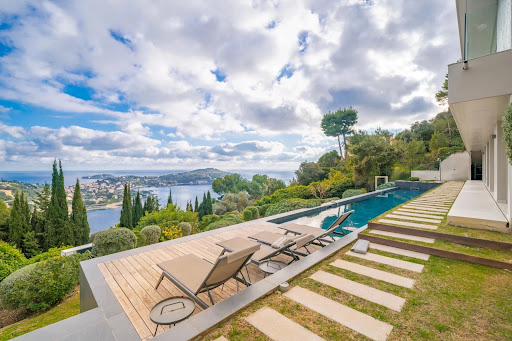


Set in a serene and secure residential neighborhood of Villefranche-sur-Mer, this exceptional contemporary villa spans 360 sqm, featuring six bedrooms and six bathrooms, and is nestled on a 2,600 sqm plot. The property offers breathtaking panoramic views over the bay of Saint-Jean-Cap-Ferrat, creating an unparalleled setting on the French Riviera. Designed with top-of-the-line finishes and generous living spaces, the villa includes expansive interior and exterior areas for elegant entertaining and relaxation. Premium amenities comprise a swimming pool, a hammam, a private elevator, a car lift, and a separate staff apartment. Just minutes from the beaches, the port, boutiques, and renowned restaurants, this residence perfectly combines sophistication, comfort, and a prime Côte d’Azur location.
…By David Luxury Properties


In the sought-after area of Super Cannes, this stunning contemporary villa of 560 sqm offers breathtaking sea views and has been built with high-quality materials. It includes 5 en-suite bedrooms, including a master suite, as well as a spacious living room with an equipped kitchen and dining area, opening onto the garden with a pool. The amenities of this property are enhanced by a heated indoor pool, a cinema room, a fitness room, and a spa. A home automation system with remote activation and high-end security services have also been implemented. The 2,207 sqm land features a garage and a pétanque court, further adding to the exceptional nature of this property. A garage and petanque area complete this exceptional property.
…By Sophie Peirano Real Estate


The notarial office SAS DAUDRUY et associés, SCP offers you: Manorial house for sale in Immo-interactif - - - - - - - - - - - - - - - - - - - - - - Property address: 72 Rue Charles Michels 93200 ST DENIS - - - - - - - - - - - - - - - - - - - - - - INTERACTIVE NOTARIAL SALE A remarkable architectural dwelling to be restored, built between 1853 and 1855 by Architect Théodore LACHEZ and constructed using the 'pise' method. 858m² to be reinvented developed over three levels, the building is currently in a very degraded state of conservation and requires extensive restoration and rehabilitation. The property is registered in the inventory of Historical Monuments, which means that any restoration or transformation project must comply with regulatory provisions applicable to protected buildings. The entire parcel of 2,993m² is classified as a classified wooded area and is also subject to a reserved location, which means that any restoration or transformation project must comply with regulatory provisions applicable to protected buildings. - - - - - - - - - - - - - - - - - - - - - - Contact: 06.07.73.41.23 - - - - - - - - - - - - - - - - - - - - - - Sale conditions: The property is presented in Immo-interactif with a starting bid of: - First possible offer: starting from 1,260,000 euros (negotiation fees included) - Subsequent offers: multiples of 10,000 euros. - Reception of offers from 03/11/2026 at 14:00 to 04/11/2026 at 14:00 on the Immo-interactif® site. - - - - - - - - - - - - - - - - - - - - - - Announcement from the study SAS DAUDRUY et associés - Notaries in Senlis - SIRET No: 31504143400020 - - - - - - - - - - - - - - - - - - - - - - Immo-interactif®: the real estate auction system that is unconstrained, transparent, and secure, offered by your notary.This description has been automatically translated from French.
…By Immo-interactif


Located within one of the French Riviera’s most sought-after private and gated estates, this exceptional villa, entirely rebuilt in 2024, offers a rare lifestyle combining prestige, serenity and accessibility. Set in a commanding position and sheltered from any disturbance, it enjoys absolute peace and breathtaking panoramic views over Cap d’Antibes, the Mediterranean Sea and the surrounding hills, enhanced by an ideal south-western exposure. Offering approximately 400 sqm of living space, the property stands out for its generous volumes, abundant natural light and the impeccable quality of its finishes. The elegant and open reception areas flow seamlessly around a contemporary semi-open kitchen, designed for refined indoor-outdoor living. A sumptuous ground-floor Master suite, featuring a full bathroom and bespoke dressing room, completes this level. The villa offers a total of five bedrooms, including a remarkable independent triplex suite, providing absolute comfort and complete privacy for family and guests. Every space has been thoughtfully designed to meet the highest standards of a turnkey, ready-to-live property. Outdoors, the flat landscaped garden features a large swimming pool, a jacuzzi and a covered summer kitchen, creating an elegant and welcoming setting, perfect for enjoying the Riviera lifestyle. Just 15 minutes from Nice International Airport, this rare property combines a strategic location, security and truly exceptional views. Condominium: Yes | Annual charges: €5,520 Energy rating: C – Climate rating: A / Estimated annual energy costs for standard use: between €3,366 and €4,554 (reference year: 2021) Information on the risks to which this property is exposed is available on the Géorisques website: www.georisques.gouv.fr
…By Barnes Saint-paul-de-vence


A jewel of Aix's architectural heritage, the Hôtel d'Oraison is a grand private mansion whose origins date back to the late 16th century. Initially the property of Henri de Raffelis, it welcomed among its guests the Duke of Guise, Governor of Provence, reflecting from its very beginnings a prestige of the highest order. It was in the 18th century that the building took on its current form: the Marquis d'Oraison, Mathieu Fulque, acquired and merged several houses between 1731 and 1736 to compose an architectural ensemble befitting his rank. The result is a majestic seven-bay façade adorned with vertical rustication, windows featuring acanthus ornamentation and mascarons, as well as two carriage gateways, one of which is crowned by an elegant balcony with a triangular pediment — all hallmarks of Aix's Baroque style in its full splendour. Confiscated during the Revolution in 1792, the mansion passed through the centuries in the hands of notable figures and prominent members of the city's academic community, before being listed as a historic monument in 1987 and carefully restored in 2012. The building is currently divided into individual apartments, arranged as follows: - A 66.4 sqm apartment on the ground floor. - A 93.9 sqm apartment with a 169 sqm garden, spanning the garden level, mezzanine and first floor. - A 211 sqm office-style apartment on the first floor. - A 58.1 sqm apartment on the second floor. - A 104.7 sqm apartment on the second floor. - A 78.6 sqm apartment on the second floor. - A 31.6 sqm apartment on the third floor. - A 41.2 sqm apartment on the third floor. - A 35.6 sqm apartment spanning the third and fourth floors. - A 64.9 sqm apartment spanning the third and fourth floors. Period mouldings and original flooring have been preserved wherever possible. The common areas are elegant and spacious, evoking the grandeur of Aix's storied past. Some units are currently tenanted. 31 sqm garage.
…By Daniel Feau - Immeubles


EXCEPTIONAL ESTATE MOURIÈS PROPERTY IN THE HEART OF THE ALPILLES In the immediate vicinity of Les Baux-de-Provence, in the heart of the village of Mouriès, this exceptional estate is a rare property, offering a remarkable combination of heritage, exceptional volumes and high-end amenities. Formerly an 18th-century olive oil mill, the property has undergone a complete renovation and comprises a unique ensemble featuring two independent mas properties. Far from being two separate estates, these two buildings form a single exceptional domain, designed as an outstanding residential property capable of accommodating family, friends or guests in privileged surroundings. The first building, Mas du Berger, offers approximately 450 sq m of living space and is centred around a vast vaulted living room, a kitchen with adjoining pantry, and 5 en-suite bedrooms. A spa, wellness room and gym complete the property. Outside, the mas enjoys its own private garden with a pétanque court, fire pit and a 3.5 x 11 m swimming pool, creating an intimate and secluded setting. The second building, Mas du Bélier, offers approximately 900 sq m. Its generous volumes include a vast vaulted living room, a kitchen and a double-sided fireplace, 8 en-suite bedrooms, as well as several spaces dedicated to comfort and leisure: an office, cinema room, billiard room, wine cellar, spa, wellness room and gym. The interiors open onto a private garden with pétanque court, fire pit, a 4 x 15 m swimming pool and pool house. Every detail has been carefully considered to the highest standards. The worktops in both mas properties are crafted from Brazilian marble, the furniture is sourced from Indonesia, and the bathroom fittings have been selected in Italy. An exceptional choice of materials and finishes, conceived down to the finest detail, makes this property truly unique. Together, the two mas properties offer nearly 1,300 sq m of built space, providing an exceptionally rare capacity and diversity of uses within the luxury property market. This configuration lends itself perfectly to an extraordinary family residence, an exclusive property designed for entertaining, or an estate centred around the Provençal art of living, while allowing each mas to retain its own independence and identity. A private parking area completes the property, accommodating 7 vehicles and equipped with a fast EV charging station. The architecture and historic features of the buildings give the estate a distinctive character. The vaulted living spaces, generous volumes and authentic character of this former olive oil mill are complemented by a renovation designed to provide today’s level of comfort and amenities expected by an international clientele. Its location is another major asset. Situated in Mouriès, in the heart of the Alpilles, the estate enjoys an iconic Provençal setting, close to Les Baux-de-Provence and its preserved landscapes. This exceptional property is offered for sale as a whole, including both mas properties and the entire estate. The possibility of acquiring Mas du Berger or Mas du Bélier individually is also available. A rare and confidential property.
…By Terres De Domaines


Magnificent contemporary villa of approximately 475 m² (non–Carrez), offering breathtaking views over the Bay of Eze Bord de Mer. The main level features elegant reception areas with a living room, dining room and open-plan kitchen. The night level includes four en-suite bedrooms, each opening onto a private terrace or garden. High-end amenities include a landscaped garden of around 1,000 m², heated infinity pool, fully equipped pool house, air conditioning, alarm system, automatic irrigation, and pétanque court. A double garage and additional parking complete this exceptional property.
…By David Luxury Properties


A property in an excellent location, just a stone’s throw from the village, at the end of a quiet cul-de-sac. Set on 2,538 m² of landscaped grounds, it comprises a main villa and a studio/gym chalet at the far end of the garden. All bedrooms have en-suite bathrooms and the living room is on the ground floor with a welcoming terrace for guests; the whole property overlooks the swimming pool. The pool area features a pool house and a bar. You’ll love the old outbuilding housing the wine cellar, as well as the children’s treehouse. The garden features a large lawn and offers charming views, particularly from the terrace of the gym. This villa is perfect for enjoying Provence and the hinterland. The beaches of Théoule and Cannes are half an hour away. Enjoy!
…By Michaël Zingraf Christie's International Real Estate Cabris


Just steps from the banks of the Cher River, in the heart of the medieval town of Montrichard, this remarkable 15th-century residence—classified as a Historic Monument—embodies the timeless elegance of the Loire Valley’s heritage with rare authenticity. The result of an exemplary restoration carried out in 2008 in collaboration with the *Architecte des Bâtiments de France* (State Architect for Historic Buildings), the property strikes a subtle balance between the nobility of its original architecture and the comfort of contemporary interiors. Spanning nearly 290 m² of floor area across four levels (236 m² *Loi Carrez*), it now houses four character-filled apartments, each with its own unique identity: a charming studio, an elegant one-bedroom apartment, a one-bedroom duplex, and a spacious two-bedroom duplex. The first-floor apartments open onto two delightful, secluded courtyards—true havens of serenity shielded from view. The ground floor currently accommodates two commercial spaces in the town center. Their layout also allows for the possibility of converting them into two apartments. Beyond its remarkable architecture, this property offers a rare opportunity to own a piece of history in an exceptional region, in the immediate vicinity of the Loire Valley’s most prestigious châteaux and landscapes listed as UNESCO World Heritage sites. An exclusive address where heritage, art de vivre, and investment potential blend with rare elegance. A property designed for lovers of historic homes seeking a truly unique setting. Sotheby's International Realty Blois Val de Loire Sologne Contact: Nathalie Durand Phone: 06 48 48 70 83 Commercial Agent RSAC 519 502 330
…By Val De Loire Sologne - Sotheby's International Realty


21e Arrondissement is proud to present this authentic 1931 Tjalk houseboat, moored at the foot of the Eiffel Tower and just moments from the iconic Bir-Hakeim Bridge, offering an exceptional lifestyle in the heart of Paris. With approximately 110 sqm of living space complemented by a 20 sqm terrace, this unique floating home combines timeless charm, original woodwork, abundant natural light, and privileged views over the Seine and some of Paris's most famous landmarks. The main living area features a fully fitted kitchen opening onto a spacious double reception room with a wood-burning stove, a bedroom with built-in storage, a dressing room, and a bathroom with WC. At the stern, the original wheelhouse and former bargeman's quarters have been carefully preserved, providing a distinctive atmosphere and additional independent accommodation including a kitchenette, shower cabin, and separate WC. The engine room is fully equipped and fitted with a propulsion engine, allowing the vessel to remain navigable. The houseboat is connected to all urban utilities, including mains water, electricity, sewerage, and high-speed fibre-optic internet. This rare riverside property represents a unique opportunity for buyers seeking an alternative lifestyle in one of Paris's most prestigious and sought-after locations. The occupancy permit (COT) and all administrative documents are up to date and renewable upon transfer of ownership. No Energy Performance Certificate (DPE) is required for this type of property. As the sale concerns a movable asset rather than conventional real estate, no notary fees apply.
…By Xxie Arrondissement


Set in the picturesque village of Oppède, this magnificent 380 m² property offers the perfect blend of Provencal charm and modern luxury. With 8 spacious bedrooms and 15 rooms, the estate boasts refined interiors including a large living area with fireplace, an elegant dining veranda with garden views, and fully equipped kitchen. Every detail has been considered for optimal comfort, including air-conditioning, double glazing, aluminum windows, double flow ventilation, and high-speed internet. Outdoors, immerse yourself in the Mediterranean lifestyle: relax by the swimming pool, enjoy friendly games on the boules court, or entertain guests with a barbecue in beautifully landscaped gardens. Fitness enthusiasts will appreciate the custom fitness area while the caretaker house ensures service and privacy for residents. Additional practical features include a car port, irrigation sprinkler system, crawl space, fence, and outdoor lighting. Security and convenience are paramount with amenities such as an alarm system, digicode, intercom, electric gate, videophone, and dedicated security service. This property is a rare opportunity to own an exquisite, fully equipped retreat in the heart of the Luberon, combining tranquility, privacy, and sophistication for an unparalleled living experience.
…By Caroline D'avril


Exclusive Listing – Domaine du Cap Bénat Exceptional Seaview Property with Infinity Pool and Walking Access to the Beach Nicolson Realty is delighted to present, exclusively, a remarkable property located within the prestigious private Domaine du Cap Bénat. Set in an elevated position, the villa enjoys panoramic sea views, absolute privacy, and direct pedestrian access to the beaches and the tennis courts of the estate. The coastal footpaths lead to Portofino beach in less than five minutes. Offering approximately 350 sqm of living space, the property is divided into two distinct buildings and comprises 6 to 7 bedrooms, including a vast master suite occupying the upper floor, complete with study, dressing room, bathroom, and a private sea-facing terrace. The reception areas unfold in succession, featuring two spacious living rooms followed by a dining area and an open-plan kitchen extending seamlessly to the terrace and the infinity pool. Built in the early 1980s, the villa has been designed for mainly single-level living, with the upper floor dedicated to the master suite and study. The layout enhances a refined indoor-outdoor lifestyle: the main living room opens onto a wide shaded terrace, creating a natural extension of the interiors. The large infinity pool, set against the sea, is complemented by a summer kitchen and bar, offering a convivial setting for entertaining. The night quarters include two en-suite bedrooms with direct access to the pool terrace, two further bedrooms in a quieter part of the villa, and two independent guest suites, allowing each guest to enjoy privacy and comfort. Highlights Prestigious private and secure Domaine du Cap Bénat Elevated position with breathtaking sea views Walking access to Portofino beach (5 minutes) Infinity pool, summer kitchen, and bar overlooking the sea Family villa with 6/7 bedrooms, ideal for hosting Generous volumes and fluid indoor-outdoor circulation Absolute privacy and optimal sunlight exposure This property combines a rare set of qualities: prime location, privacy, panoramic views, and immediate access to beaches and amenities. A truly unique opportunity within one of the Mediterranean’s most sought-after coastal domains.
…By Nicolson Realty
'%20stroke='%23DDAA3A'%20stroke-width='1.909'%20stroke-linecap='square'%20stroke-linejoin='bevel'/%3e%3c/svg%3e)
Receive by email any new listing that may match your search criteria
Your criteria :
By validating this form, you accept the general conditions of use of Le Figaro Properties.
These agencies offer a selection of luxury properties vente in France. Feel free to contact them for personalized assistance.
For your search for an exceptional property, select from our luxury houses with panoramic views in France, starting at $232,023. Offering exceptional panoramas, these 4,304 residences overlook the city and its surroundings. As the seasons pass, the spectacle is renewed without ever becoming tiresome. Depending on the area you are looking for, such as Provence-Alpes-Côte d'Azur, Rhône-Alpes and Aquitaine, the living areas may vary and start at a minimum of 1 m². The largest properties rise to 13,299,999,744 m².
As part of your search for a luxury property, discover our catalog of 19,547 luxury houses with a terrace in France, offered from $205,604. Outdoor meals or summer receptions, the terrace extends the house outdoors. Property listings are found in particular in Provence-Alpes-Côte d'Azur, Aquitaine and Rhône-Alpes. The houses listed in our listings offer attractive living areas measuring between 1 m² and 570,000 m².
Set down your suitcases without waiting: our catalog brings together 1,926 furnished luxury houses in France, with a starting price of $229,726. From the living room to the bedrooms, each residence is tastefully furnished and ready to live in. Property listings are particularly numerous in the following areas: Provence-Alpes-Côte d'Azur, Rhône-Alpes and Aquitaine. The average price of this furnished stock stands at $10,882 per square meter. Living areas reach 40,000 m² for our largest properties.
As part of your search for properties of excellence, browse our privileged selection of 19,331 luxury houses with a pool in France available from $229,726. These exceptional residences enjoy prime locations, particularly in Provence-Alpes-Côte d'Azur, Aquitaine or Languedoc-Roussillon. Whether the architecture of these houses incorporates a covered indoor aquatic space or a vast outdoor pool, each property flourishes amid remarkably landscaped grounds measuring between 2,000 m² and 13,300 ha.
Your receptions deserve a setting to match: discover 480 luxury houses with a reception room in France, starting at $278,450. These residences combine family privacy with spaces dedicated to major events. Family gatherings, business dinners or parties with friends naturally find their place there. The fashionable addresses are located in Provence-Alpes-Côte d'Azur, Aquitaine and Languedoc-Roussillon. Depending on the property, the property area extends up to 953 ha.
The beach as an extension of the garden: this is the spirit of 3,608 luxury houses by the sea in France, for sale from $364,115. Your life there will be organized to the rhythm of the coastline, between sea bathing and walks. Provence-Alpes-Côte d'Azur, Corse and Aquitaine enliven the local market. In these residences, the minimum recorded living area is 39 m².
The sea horizon as a guiding thread: explore the 3,995 luxury houses with sea views in France, with prices starting at $290,557. The sea accompanies your days, from sunrise to the last light. A daily privilege that few addresses can claim. Browse the listings in Provence-Alpes-Côte d'Azur, Corse or Bretagne first. In terms of dimensions, the living areas start at a minimum of 39 m² and the grounds at 2,000 m².
Anchor your daily life at the water's very edge: this is what the 281 luxury houses right on the water in France allow, for sale from $382,876. These rare residences provide direct access to the shore, with no obstacle to cross. In the geographical area, Provence-Alpes-Côte d'Azur, Corse and Bretagne account for a significant share of our listing catalog. The average price per square meter stands at $16,436. Expect living areas measuring between 42 m² and 126,804 m². In our selection of listings, a property can have up to 32 rooms.


