Get early access to listings that match your criteria
Never miss an opportunity again. Our personalized alerts notify you instantly.

 English$ USD · m²


A 750-m² renovated villa, owned by the same family for the past two centuries, with 4.5 hectares of farmland, a swimming pool and vast grounds, near Toulon. The property, facing north-south, covers an immense rectangular-shaped area of 4.5 hectares. Accessible from the B road to the south via the main entrance, followed by an olive tree-lined lane of nearly 200 metres, the property also has a second, more discreet entrance, located on its northern side and accessible via a small public road, while two wooded areas can also be found on the property: one to the north, near the buildings and, the other, to the southwest. As for the property, currently used for weddings and seminars, it would also be ideal, after some minimal modifications, as a family residence, a bed and breakfast or charming holiday accommodations. The edifice, built in 1730 and then meticulously renovated in 2012, displays the classical appearance of a three-storey construction, cadenced by five vertical rows of windows and topped with a hipped roof. Abutting the northwest side of the villa is a 17th-century building, also renovated, which includes a professional kitchen on its garden level and a caretaker’s flat upstairs. As for the villa, it is preceded by a glass entrance porch, which opens onto an entrance hall and includes two living rooms on its garden level, three other sitting rooms, a nuptial suite and a study on the first floor, while the occupant’s private living quarters, with four bedrooms and accessible via an independent staircase, are on the second floor. As for its exterior, a large gravel patio runs along the length of the façade and is decorated with a circular ornamental pond, while the swimming pool area is located below to the east of the central drive and, given its size, makes it possible to regularly host wedding receptions under tents that are set up during the summer months. In addition, the two side sitting rooms and the office on the first floor could also be reconverted into bedrooms with lavatories for a total of ten bedrooms in all, including the caretaker's flat. Lastly, a number of outbuildings are located in the property’s wooded section extending to the north of the villa, such as: a garage, storage rooms, a vaulted cellar as well as a giant rainwater tank and an old well.
…By Patrice Besse


An eighteenth-century Provençal house 15 minutes from Orange TGV station, in the historical county of Venaissin with 2.4 hectares of wooded grounds and a view of Mount Ventoux. This property was once part of a vast, plain, farming estate, of which it still has 2.4 ha of land. The constructions stand on the north-east side of its land on a knoll, circumvented by a meander of the Carpentras canal, marking the northern limit. The main entrance, leading to a courtyard, is provided by gates on the south-west side, facing the estate’s land. On the north-east side, a high wall, lined with unsquared surface limestone, encloses the courtyard; a little door in this perimeter wall makes it possible to reach an outstanding stand of oak trees, on the north slope, bordered by the canal. The main building is a traditional Provençal country house, constructed at the end of the 18th century, even the beginning of the 19th century, probably on the foundations of an earlier construction, notably visible in the enclosed courtyard courtesy of the vestiges of old blocked up windows. It spans two levels and faces southwards over the courtyard. It is symmetrically and harmoniously composed and topped with a triple overhanging cornice, forming the eaves. Its lime-rendered walls feature aligned openings, framed with painted surrounds, enhanced with red edging. The north-east corner of the country house features a wide, drop arch, carriage door, topped with a virtually square opening, indicating a probable reconstruction of the country house’s east gable or a vestige of an earlier construction. A square, single-storey pavilion, topped with a roof terrace, bears witness to an earlier building, possibly a 2-storey dovecote. Reached via steps on the west facade, it marks the southern limit of the country house. It is extended by a terraced area, supported by a dry-stone wall, containing a swimming pool that closes the courtyard. And lastly, the parklands extend over the top of the open area to the south of the courtyard. Planted with Mediterranean species, notably convoluted pine trees, they still include some decoratively trimmed boxwood and a masonry well, topped with a local limestone dome.
…By Patrice Besse


In a typical village of Haut-Var, a 17th-century house and its enclosed garden with a swimming pool. The village house modestly expresses the elegance of Provençal homes. On the street side, the ochre facade, balanced and warm, contrasts with sage green shuttered windows, topped with four oculi framed with a light decor reminiscent of the stone arches of the ground floor's windows, as well as the central door. On the courtyard side, the white facade, largely covered with virgin vine, is rhythmically punctuated by high arched windows with pale blue shutters, which diffuse a soft and even light throughout the space. The paved, sheltered, and intimate inner courtyard combines old stone, patinated walls, and climbing vegetation. In the shade of the facades, the space becomes a privileged living area in fine weather.This description has been automatically translated from French.
…By Patrice Besse


A traditional Provencal farmhouse and its garden of more than 8,000 m², thirty minutes from Vaison-la-Romaine in the Vaucluse department. The property is accessible via an electric gate, which opens onto an entirely enclosed and meticulously maintained garden. Once past the entrance, one’s gaze is immediately drawn to the way in which the buildings have been elegantly arranged around the property, while the stately main dwelling, abutting an immense storage shed, is characterised by its thick lime-plastered walls, which help absorb the dazzling sunlight, and its typically Provencal genoise corbels. Organised in a U shape around several outdoor spaces designed for relaxation, the farmhouse naturally hugs the property’s topography and seems to melt into the landscape in typical Provencal fashion, whereas, in true southern tradition, its north-south orientation ensures optimal sunlight and natural protection from the Mistral winds. In addition, a breath-taking Mediterranean mosaic extends around the property’s garden: rows of vineyards and olive trees create a verdant setting, while, not far from the dwelling, a rectangular swimming pool, Jacuzzi and sauna, carefully shielded from view thanks to dense hedges, provides a pleasant oasis. Lastly, a second dwelling, set back and hidden behind the main dwelling, was converted into a holiday cottage.
…By Patrice Besse


30 minutes from Aix-en-Provence, in a large character bastide, a duplex and its private garden on a 3-hectare private estate. On the estate, besides the castle that served as a wine cellar in Roman times, three bastides were built in the 17th century. One of them underwent complete restoration about fifteen years ago with quality materials by a renowned architect, who divided it into apartments. The large bastide, surrounded by vineyards, is accessible from a wrought iron gate framed by two stone pillars and consists of several buildings of different shapes and heights. The walls of the buildings have been coated with ochre yellow lime. The whole is topped with gabled roofs made of canal tiles, typical of the region. On the eastern side of the central building, a courtyard with two stone basins is lined with plane trees. The clever layout of the windows of the apartments, protected by wooden shutters, and the adjoining gardens, allows each to maintain its privacy. The elegance of the building is highlighted by the cypress trees planted on either side. At the back, an olive grove and a large swimming pool serve as common space. A little further down, an additional area has been created and serves as parking space for residents.This description has been automatically translated from French.
…By Patrice Besse


On the outskirts of Aix-en-Provence, less than 30 minutes from the train station and the airport, a 300 m² bastide with a swimming pool, set in a wooded and enclosed park of nearly 2,000 m². Surrounded by greenery, the estate is situated away from an urban thoroughfare. Below, a wooded and classified hillside ensures an unchanging horizon. Furthermore, the property, enclosed by walls and hedges, protects the privacy of its occupants while allowing the Provençal light to enter. Integrated into a residence, although completely independent, it is thus quiet and perfectly secure. The old bastide, whose origins date back to the 17th century, reflects the Aixois art of living, balancing classic rigor and southern elegance. Rectangular in plan, it offers more than 300 m² of living space, spread over three levels. The dressed stone elevations are coated with lime and topped by a traditional canal tile roof finished with a double eave. The monumental door built of Bibémus stone, topped with a cherub's head, recalls the original residential purpose of the place. The windows, symmetrically positioned around this door, are closed by wooden small-paned joinery and complemented by wooden shutters. The bastide was enlarged to the east by a veranda illuminated by large iron windows and topped with a terrace roof covered by a pergola. Two renovation campaigns in 1999 and 2006 have allowed for a blend of heritage and comfort: careful insulation, modern heating, and discreet air conditioning.This description has been automatically translated from French.
…By Patrice Besse


On the heights of Cavalaire, a villa with building potential, its landscaped garden of 1,500 m² and its swimming pool, 900 m from the sea. From Le Rayol or La Croix-Valmer, the coastal road accesses the residential area of Parc de Cavalaire, where the property is located. Built on one of the town's hills, the house, at the end of a cul-de-sac, is about 900 m from the sea, in a preserved environment free from noise and visual nuisances. A paved path leads to two parking spaces that run alongside the house on one side. Raised by one story on its half and extending to nearly 200 m², the villa was built in 1983 and then enlarged the following year. In Provençal style, with its understated facades of stone blocks covered with ochre plaster, its asymmetrical straight windows, its two-pitched tiled roof, and its two-row cornice, the house was constructed in a dominant position on the plot. On three sides, the house is extended by a terrace, one of which, to the west, is covered by a trellis set up as a dining area for summer. In the foreground, backed by a dry-stone terrace, a rectangular swimming pool and its large semi-circular beach create a beautiful view of the surrounding hills. The garden, about 1,500 m², well-maintained and lush, is rich in a remarkable diversity of plants dominated by a phoenix palm, while the sea comes into view through the vegetation on the horizon. The villa has a living room, a dining room, a kitchen, an office, five bedrooms, and two shower rooms. It is adjoined by an old garage converted into an independent studio of nearly 20 m², ideal for accommodating family or friends. The whole enjoys a calm and green setting typical of a seaside residence.This description has been automatically translated from French.
…By Patrice Besse


On the heights of the Jabron Valley, 10 minutes from Sisteron, a hamlet from the 17th and 18th centuries transformed into a lodging place. The property extends over a plot of about 7,000 m², organized around two distinct built ensembles in local stone, covering an area of more than 800 m². The complex, which dates back to the 17th and 18th centuries, underwent renovation between 2017 and 2023, preserving ancient elements and adapting the place for lodging activities. The terracotta floor tiles, several original architectural features, and the volume of the buildings have been preserved, while the technical equipment has been modernized to meet current needs. Access to the estate is via a staircase bordered by driftwood leading to an old central courtyard that organizes the circulation between the various buildings. Below, a covered terrace extends the living spaces for large tables during events. Water also structures the surroundings: a swimming pool set apart and a pond animated by a small waterfall in the central courtyard introduce a discreet sound presence. The outdoor areas feature varied vegetation, including fruit trees. At the top, a shaded wooded park houses a wooden terrace as well as an independent lodging in the form of a nomadic tent, designed for a stay in the heart of nature.This description has been automatically translated from French.
…By Patrice Besse


In a secluded spot, near Brignoles and the villages of Haut-Var, lies a Provençal bastide with a swimming pool, set on a 1.5-hectare estate. At the end of a discreet path, the place gradually reveals itself. The eye is first guided by the dry stone terraces that organize the space, and then by the presence of water. Coming from an abundant spring, it flows in channels over the stone, runs along the walls, accompanies the paths, and animates the garden with a constant murmur. The bastide, built between 1978 and 1982, consists of two levels with interlocking volumes, one of which is slightly recessed. The façades, with their ochre-yellow render, partially covered with ivy, are pierced with light-shuttered windows. The two-pitched roof is made of canal tiles. Set back, an outbuilding extends the living space: a veranda open to the garden is divided between a kitchen and a summer living room, sheltered by the pine forest. The land, planted with pines and Mediterranean species, alternates between open areas and shaded spaces; a swimming pool has been installed there.This description has been automatically translated from French.
…By Patrice Besse


In the north of Vaucluse, between Vaison-la-Romaine and Grignan, a fully restored village house with a courtyard and independent studio. The residence, built in the early 19th century on older foundations from the previous century, spans around 220 m² and consists of three levels. It is centered around a large courtyard. Access from the street is through a coach entrance framed by cut stones that leads under a porch. Its southwest exposure ensures good brightness for the various interior spaces. The exterior walls are made of lime jointed stone, with mostly straight openings, hewn stone, and regular-sized formats, featuring recent wooden windows and French doors with small panes and green-painted shutters. The facade is very simple, with minimal ornaments limited to key lintels and the framed openings in molded stone. It is topped with a two-slope roof made of canal tiles, bordered by a two-tier eave. Transformed in the 1980s and then renovated in 2020-2021, the house has managed to retain the character of a village dwelling while incorporating a touch of modernity, notably through the waxed concrete flooring on the ground floor and part of the second floor. The living space traditionally includes a living-dining room and a kitchen on the first level, while the two upper levels encompass four bedrooms with private shower rooms. It benefits from a south-facing courtyard, enhanced by a water feature, which provides a particularly enjoyable space for relaxation and refreshment in the region. Lastly, at the opposite end of the house and extending from the porch, there is a small two-level building that houses a studio, a laundry room, and a bike garage.This description has been automatically translated from French.
…By Patrice Besse


An entirely renovated 17th-century mill, with its swimming pool and outbuildings on 7,500-m² grounds, to the north of the Luberon Mountains. Thanks to its environment and impeccable preservation, the property enjoys a verdant setting where a river still supplies water to the mill. From a secondary B road, a lane winds its way through a forest of live oaks, before reaching the mill, built in a clearing at the top of a small hill and accessible via a carriage entrance at the end of a gravel drive. Shielded by a curtain of vegetation, a peaceful river borders one side of the property’s fertile grounds, while, a little further on, a wooden pedestrian gate, located at the top of a flight of stone steps and framed by two cypresses, opens on to the swimming pool area, concealed from view by a pointed stone building on one side and a hedge on the other. In addition, behind the carriage entrance, three buildings, one of which is placed at a right angle, are grouped around a central cobblestone courtyard, which is closed off on one side by a low stone wall overlooking the grounds. Topped with barrel tile roofs, the one crowning the main dwelling is highlighted by a double genoise cornice.
…By Patrice Besse


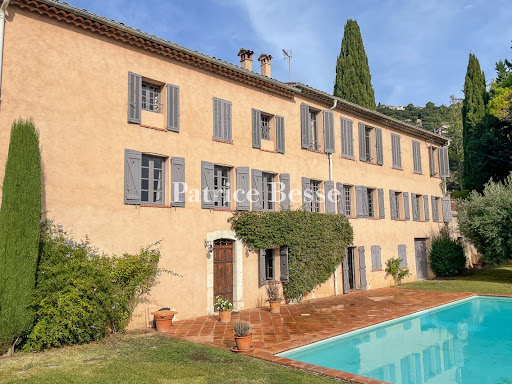

A large 18th-century Provencal country house, with its gardens and sea views, in the middle of the world’s perfume capital. A few minutes from the historical downtown area of Grasse, the property is made up of a group of buildings surrounded by vegetation, in the middle of the city, while, perched halfway up the hillside, it enjoys unobstructed panoramic views of the sea and the neighbouring countryside. Situated on a plot of land of more than 4,000 m² and nestled within a rolling landscape, it is made up of a long rectangular main building, as well as a caretaker’s cottage. The first is a three-storey construction typical of the 18th century, which was most likely extended lengthwise later on, judging how its roof changes in height almost at its centre, while the second building, located at the property’s entrance, is more modest in size, of similar craftsmanship and from the same period as the main dwelling. Featuring solid constructions, with thick local stone walls covered in light-colour plaster, rectilinear windows placed densely and symmetrically throughout, ashlar stone window/door surrounds or brick window ledges, as well as barrel tile gable roofs, the property also includes, in front of the main dwelling and facing mostly south, a flat swath of lawn with a swimming pool as well as a terraced garden flourishing with vegetation.
…By Patrice Besse


To the west of Var, in nature and 20 minutes from the seaside, a restored stone farmhouse with a swimming pool, outbuildings, and unique accommodations. The farmhouse is accessible via a small communal road and then a dirt path about a hundred meters long, which also serves two other properties. A parking area protected by vegetation precedes a stone shed and marks the entrance to the property, whose ground is treated with gravel. The farmhouse, dating back to the 19th century, bordered by a terrace covered with travertine, is oriented to the south. It opens onto a vast flat area overlooking a swimming pool. Its unjointed stone facades are topped with a two-pitched canal tile roof and edged with a two-tiered cornice. Elevated over two levels, the main building has four upright openings on the upper floor and three French doors on the ground floor, whose masonry frames are typically southern. Attached to its eastern side is an independent studio that opens onto a terrace through a wide double French door. Its roof is flat and serves as a terrace and access, via a back staircase, to a second, larger studio. In front of the terrace delimited by a dry stone wall and two mulberry trees framing a few steps, extends a gravel and grassy area, from where there is a wide view of the vineyards in a hilly landscape. At the eastern end of the land, among hundred-year-old olive trees, two boxes with their private spaces have been arranged for 'unique' seasonal accommodation. To the west, below the swimming pool, there are a vegetable garden, fruit trees, and a well that provides them with the necessary water.This description has been automatically translated from French.
…By Patrice Besse


Luxury and refinement define this unique property with its high-end amenities. In a peaceful and secure setting, discover a property boasting exceptional sea views and offering a refined and tranquil lifestyle. From the moment you enter, the generous proportions and natural light reveal an elegant living space, designed to be both open and intimate. High-quality materials and meticulous finishes underscore the resolutely contemporary character of the property. The sleeping area offers several suites, combining comfort and privacy, as well as numerous bespoke layouts. Outside, a relaxation area around the infinity pool and several terraces harmoniously complete the ensemble. A rare find, marketed discreetly. Full details available upon request after a qualified consultation. Reduced notary fees ENERGY RATING: B (79) / CLIMATE RATING: A (3) Estimated average annual energy costs for standard use, based on 2021 energy prices: between euros1,620 and euros2,250 per year. Condominium with 256 residential units. No ongoing legal proceedings. Annual charges: euros1,200. Information on the risks to which this property is exposed is available on the Géorisques website: www.georisques.gouv.fr Muriel Condominiums of 256 units. Annual expenses : 1200 euros.
…By Espaces Atypiques Toulon


In Marseille, near the Calanques, a villa with a pool on nearly 1600 m². In a cul-de-sac, away from the noise of the city, an ornate iron gate marks the entrance to the property. A driveway initially runs alongside a pool, then crosses the landscaped park before reaching the villa, hidden in the greenery, which provides a welcome coolness during the summer heat. The property consists of three buildings arranged to form an inverted U, each covered with mechanical tiles. Large bay windows, protected by wooden panels or shutters in need of restoration, break up the façades. The first, central building, oriented east-west, serves as the main entrance, slightly set back from the other two. It houses a kitchen and distributes to two other volumes as well as a garage. On the first floor, two units with bedrooms, bathrooms, and toilets are extended by terraces. The second building, to the west, connected to the previous one by a diagonal south-west/north-east, contains a living room equipped with a fireplace. Finally, the third building, located to the east, perpendicular to the main body along a north-south axis, comprises three bedrooms as well as a shared bathroom. The ground floor alternates between terracotta and cement tiles. The house is equipped with electric heating and air conditioning.This description has been automatically translated from French.
…By Patrice Besse


A 20th-century Mediterranean villa with a sea view and over 5,000m² of grounds, nestled near Toulon in south-east France. An electric metal gate leads into the property. A winding driveway, lined with stone walls and vegetation, stretches 150 metres. This drive leads to a gravelled court where two age-old olive trees tower. The dwelling has a ground floor, a first floor and a second floor in the roof space. It offers a liveable floor area that is currently around 250m². A basement adds 130m² to the floor area. The villa is classical in style. It faces north and south and is made of rubble stone, coated with pale ochre rendering. Many openings punctuate the facade, with large-paned windows and glazed doors fitted with shutters painted green. The edifice is crowned with a gable roof of barrel tiles, underlined with a double-row génoise cornice. The window surrounds and roof stringcourse are white, bringing out the ochre tone of the rendering and all the other colours of the whole. On the south side, there is a terrace with a court with olive trees. Here you can admire a view of Toulon’s natural harbour and the sea. On the west side, there is a second terrace. It offers a view of the surrounding hills and the grounds, which are terraced with dry-stone retaining walls.
…By Patrice Besse


Close to the Verdon gorges, in the Var hills, a small 19th-century bastide has been enlarged, set in a 1.7 ha park dotted with pines and olive trees. Less than 5 minutes from the village via the departmental road, access to the fully enclosed property is through a wrought iron gate framed by walls. On the northern edge, the main body of the building forms a harmonious ensemble of square volumes topped with pediments. The former small country bastide from 1808, renovated and extended in 2000, blends with a contemporary wing of similar inspiration, resulting in around 350 m² of living space. The whole structure faces south and overlooks a 1.7 ha park punctuated by pines, olive trees, and other Mediterranean species. The two sections, connected by a large open-plan room that runs through, maintain the coherence of an imposing building, with facades coated in white lime, punctuated by symmetrical openings lined with gray shutters. The railings of the first floor of the former sheepfold are adorned with wrought iron work. The two-pitched roofs and the double eaves emphasize their elegance. The south, west, and north facades are bordered by large gravel terraces. The one to the south, with its two plane trees, opens onto a panorama of hills and scrubland and leads, by a stone staircase, to an alleyway alternately lined with cypress trees and hedges. This leads to a fountain, while the one to the west creates a dining space in the shade of a two-hundred-year-old tree. At the back of the building, to the north, a parking area for numerous vehicles is adjacent to a caretaker's house. Beyond, the terraced olive fields spread out, the pine forest to the east, and set back a discreet masonry pool, protected from view by stone walls and hedges.This description has been automatically translated from French.
…By Patrice Besse


A traditional Provence house with large outbuildings, a swimming pool, tree-filled garden, and 2 hectares of fig trees, near to Hyères and 20 minutes from the beaches. From the country road, a lane lined with fig trees, also leading to other houses, heads directly to the property’s entrance and its wide, sliding gate, behind which there is a large, tarmacked inner courtyard. This vast parking area serves the two outbuildings used for the farming activity but also the two-storey main dwelling and the adjacent single-storey apartment to the west. The country house, which was erected more than 20 years ago, combines the main dwelling and independent apartment. It boasts a sober and classic appearance that is respectful of Provence’s architectural traditions: a subtly toned pink rendered façade, almost perfectly symmetrically laid out rectangular windows - though some doors and patio doors are arched - pastel blue Venetian louvred shutters and, depending on the section of the building, hipped or half-hipped roofs made of half-round tiles, underlined by a double genoise corbel. Its southern façade overlooks a large patio that stretches out in front of the apartment to the west, while the approximately 800-m² garden mainly expands to the south and east. The swimming pool and pool-house are located at the southeastern tip of the garden, which is enclosed by walls and hedges, while a working, approximately 2-hectare, certified organic fig tree orchard can be found to south of the house.
…By Patrice Besse


At the gates of Sisteron, with the Jabron valley on the horizon, a Provençal farmhouse on a 1.3-hectare plot, its olive grove and its thicket. The entrance gate, to the north of the farmhouse, is accessible via a rarely traveled paved communal road, which serves a few properties and olive groves, without any overlooking. It leads to a vast courtyard that connects to a garage and the main entrance of the family house built in 1994 and facing south. The main facade opens onto a spacious summer kitchen, a true outdoor living space, with a terracotta tiled floor from Launes. Under a traditional roof with exposed flat tiles, the oak framework of Durance and the chestnut rafters form a beautifully crafted ensemble. From the courtyard, the outdoor living areas are only revealed by stepping back, using a covered passage between the garage and the farmhouse, or through the garden that runs along a thicket of oaks. A garden lounge is placed there. Located as close as possible to the first olive trees, a swimming pool, facing directly south and constantly sunlit, extends the views over the olive groves and the surrounding wooded hills.This description has been automatically translated from French.
…By Patrice Besse


A spectacular residence, dating from the 16th, 18th & 20th centuries, and its farm in a verdant, 6.5-ha setting at the foot of the Luberon mountains. The construction of this old farm, comprising three separate buildings, took place over almost four hundred years, between the 16th and 20th centuries. The gateway stands alongside a narrow lane going to the village. It gives access to a driveway, bordered with pine trees, that leads to the house. Parklands, on either side, are planted with Mediterranean vegetation. The driveway provides a view of the main, one-storey building, reflecting vibrant Mediterranean colours. A stone tower spans three levels on the west facade. A square tower, set back from the main facade on the east side, features a roof terrace, looking out over the rear parklands, with the mountain range in the distance. A small corner tower flanks the south facade of the construction. The housing continues with the stone farmhouse spanning a garden level and a partial upstairs. At the end of this building are a swimming pool and its green open spaces laid to lawn. The rear facade of the property looks out over romantic, wooded parklands, a vegetable garden and an old oval ornamental pool. A dual flight of steps goes up to the south terrace, bordered by a balustrade.
…By Patrice Besse


An imposing 900 m² house in an 8-hectare estate, interspersed with olive trees and vines in Provence, to the west of Toulon and 20 minutes from the shores of the Var department . Behind a wrought iron gate framed by stone pillars, a winding, shady cobbled driveway stretches almost 100 metres. It winds through vineyards and olive groves, then gently climbs the curves of the land to the house, which is hidden from view and blended in perfectly with the landscape. The estate covers more than 8 hectares of farmland. The house, right in the heart of this natural environment, has a total living area of around 900 m². Built in the mid-19th century, the original building faces north-south and spans around 300 m² over two storeys. Its stone façades and gable roof are typical of local rural architecture. An extension, which blends in coherently with the original building, was added around 15 years ago, perpendicularly, to the west. Facing east-west, it forms a T-shape with the old wing, and is two storeys high as well. Although designed as two independent entities, the two buildings could easily be connected to create a fluid interior flow. To the north-east, the paved driveway continues on to the various outbuildings: garages, farm buildings and storage areas. Below, on the south side, a vast 18 x 7 m swimming pool is lined with travertine decking and backed by a pool house. A little further away, to the west of the house, an equestrian structure comprising a few loose stalls and a lunge ring in need of renovation is a reminder of the estate's agricultural vocation.
…By Patrice Besse


A large architect-designed villa in a site overlooking La Seyne-sur-Mer, with a roof terrace and swimming pool, in 2,400 m² of tree-lined grounds. A tarmacked lane leads to the entrance of the property whose double-leaf solid metal gates decorated with wrought-iron arabesques are electrically powered. A stone-paved driveway leads up to the house’s porch to the left and a large garage straight ahead. The villa was built in 1967 and boasts living space of approximately 370 m². It is rectangular in shape and has three storeys that embrace the terraced lie of the land. The upper level is made up of vast roof terrace with more than 150 m² of space and views of the sea. The walls of the façades are rendered in white and are dotted with large aluminium windows as well as French windows, fitted with electric roller blinds and black wrought-iron grating for the openings on the garden level. A very large glass-paned veranda adorns the southern façade, while a triangular awning protects the entrance door. There is a gigantic lounge bathed in the light that flows through the veranda on the garden level, next to a kitchen and master bedroom with en suite facilities, while four other bedrooms and related rooms are located on the lower level, all opening onto patios that lead into the garden. The grounds are made up of several terraces planted with cork oak, pine, palm, olive and fig trees. The largest terraces play host to an outside dining space with an outside oven on one, a swimming pool with decking and pool-house on another and, lastly, a relaxation area, flower beds and a fishpond for the others.
…By Patrice Besse


A more than 140-hectare hunting estate with an 18th-century Provence farmhouse, in the Alpes de Haute-Provence area. The estate can be reached via a discrete tarmacked track that winds through the greenery to the entrance gate. Beyond the gate, the grounds of the vast, entirely fenced, 138-hectare estate, fully preserved from any hustle and bustle, are divided into two separate parts. An old edifice made from local stone and built in the 18th century can only be seen from inside the estate, tucked away in the centre of the first part of the grounds. The typical Provence farmhouse stands in the middle of meadows overlooking the valley. It is set around a central courtyard and includes several independent homes. There is a summer kitchen that is dominated by a swimming pool surrounded by a covered patio and a summer lounge, boasting a panoramic view over the Alpine relief. A second entrance on the Luberon side of the property can be reached by carefully maintained tracks. They also lead to almost 3 hectares of truffle oak trees whose produce is farmed and sold, as well as two lakes. As for the outbuildings, a large edifice contains several garages, a workshop and storage space for agricultural equipment. A well-structured kennel area is made up of twenty boxes, all of which are lit and boast a water supply. The water supply for the estate, which has become a crucial issue in southern France, is guaranteed by a 105-metre-deep borehole fitted with a submersible pump in 2020 that fills a 75-m³ water reserve equipped with a UV treatment system. Several springs and a traditional Provence stone well further enable the property to be self-sufficient in terms of water. The estate is connected to the electricity as well as telephone networks and also boasts potential for production of photovoltaic solar energy.
…By Patrice Besse


An 18th-century country house of 600 m², with natural swimming pool, park and 19-hectare olive-growing estate, 15 minutes from Avignon TGV station . This is a bastide with a history that is not easily unveiled. Its Provence name, which means 'to preserve and respect', may well refer to a Masonic practice that existed in 18th-century lodges but has since disappeared. And it was precisely at this time that the bastide was built, probably on top of pre-existing medieval foundations. A symbol in the centre of the park's majestic wrought-iron entrance gate adds to the mystery: a hexagram, or 'Star of David', suggests that the estate may have belonged to a Jewish banker in the service of the Avignon papacy. However, there are no official records to support this hypothesis, which has become a local legend. It should be remembered that the hexagram is a decorative figure found in Christian, Hindu, Japanese and pre-Islamic Arab architectural symbolism; the six branches of the star representing the six days of work, with the seventh day, the day of rest, in the hollowed-out centre of the geometry. The residence, surrounded by around 4 hectares of wooded parklands, is situated at the south-east end of a 15-hectare olive grove, criss-crossed by chequered tracks. Some of the earth paths run alongside one of the high dykes protecting the property from the Rhone River, which provides the entire estate with a much-envied wealth of silt and a constant supply of water. The bastide, at once an aristocratic residence and a farmhouse, displays all the distinctive features of its particular architectural style. As the construction of such a complex always takes time, the square, affluent 18th-century buildings were extended at the beginning of the 19th century by two lower adjoining buildings. Not far away, a single-storey outbuilding dating from the late 19th century, used as a caretaker's lodge, ensures from a distance that the peace and quiet of the bastide, a true 'manor house' surrounded by its estate, is preserved.
…By Patrice Besse


A 20th-century villa with outbuildings, a garden, swimming pool and panoramic views of the Mediterranean Sea, to the west of Marseille on the Blue Coast. Perched on a promontory, the land where the old mill once stood was gradually divided up in order to make room for several villas in the 1960s. All that remains from the former mill is a tower now encircled by the building complex, which has progressively been expanded over time. With the arrival of the train, followed by various services and amenities, the traditional lifestyle of this seaside village quickly transformed into a sought-out coastal resort town, while the proximity of the famous actor Fernandel once again increased interest in this holiday destination, secluded and yet close to several dynamic business hubs. With immaculate and rather massive architecture, including multiple building structures, but with an overall traditional appearance thanks to its ochre-colour plaster-coated exteriors, arched windows surrounded by ashlar stone as well as its barrel canal rooftops bordered by genoise cornices, the villa combines the character of yesteryear with modern comfort. As for its large glass doors and picture windows, they allow the natural light to bathe its interior and provide panoramic views of the sea, while inside, noble materials and soft tones were chosen in order to create a warm and welcoming atmosphere. In addition, the bedrooms, sizeable and sunny, were designed as individual sanctuaries, their bathrooms were tastefully decorated with several luxurious touches and the living areas, generous in size, are extended outdoors thanks to several sun-dappled patios, bordered by understated wrought-iron guardrails or stone balustrades, intended for convivial moments between family or friends as well as peaceful relaxation lulled by the wind in the pine trees. With a separate flat and recreational amenities, including an impressive swimming pool, which provide a sumptuous touch and augment the property’s inhabitable spaces, the latter seems as if to melt into the horizon like the bow of a ship, surrounded by an immense terracotta deck as well as a variety of outbuildings. Last, but not least, the garden, meticulously landscaped, is an invitation to stroll through its verdant pathways, while terraced areas lead to more intimate spaces, ideal for reading against the soothing soundtrack of the waves in the distance.
…By Patrice Besse
'%20stroke='%23DDAA3A'%20stroke-width='1.909'%20stroke-linecap='square'%20stroke-linejoin='bevel'/%3e%3c/svg%3e)
Receive by email any new listing that may match your search criteria
Your criteria :
By validating this form, you accept the general conditions of use of Le Figaro Properties.
These agencies offer a selection of luxury properties vente in Provence-Alpes-Côte d'Azur. Feel free to contact them for personalized assistance.


