Get early access to listings that match your criteria
Never miss an opportunity again. Our personalized alerts notify you instantly.

 English$ USD · m²


Orpi offers you this construction project for sale, ideally located in the sought-after Baguier sector, in the Fontsainte district, just 300 meters from the beach. Shops nearby.This villa consists of: - on the garden level: an entrance, living room with open kitchen leading to the terrace, one bedroom, a shower room with WC - on the first floor: a landing serving three bedrooms, a separate WC, and a shower room A pool enhances the garden.Marketing video available upon request. Don’t hesitate to contact us! Notary fees will be calculated on the sale price of the land.Agency reference: 2259This description has been automatically translated from French.
…By Orpi - Agence Paris Mer Le Port


The advertiser did not provide an english description for this listing.
…By Patrice Besse


The advertiser did not provide an english description for this listing.
…By Patrice Besse


In Pradet, a 5-minute walk from the beach, with a view of the sea and the mountains, a 1950s house remodeled like a boat, with terraces and a garden. Originally built in the 1950s as a simple cabin by the scrubland, the dwelling was enlarged in the following decade to reach 140 m² on the ground and three levels, primarily facing north, east, and west, which helps maintain its coolness in the summer. It is located in a residential area, protected from any overlooking properties. The land, formed of small terraces, has been optimized with many wooden decks and intimate spaces over nearly 450 m², providing various views of the sea. The main facades, facing east and north, are pierced by two square bays per level and coated with a smooth ivory plaster. The double-pitched roof covered with canal tiles is bordered by a double eave. The house was designed following principles of continuity and fluidity between indoor and outdoor spaces. The garden level thus communicates on the north side with a veranda, on the roof of which a terrace has been created, while a second extends at the same level, above a pergola, with a sea view enlivened by the movements of boats. To the east, a terrace close to the kitchen is particularly suited for sunny breakfasts. Lastly, built on the upper floor and adjacent to the master bedroom, a small terrace overlooks the port. The house was conceived in a maritime spirit, like a vessel with decor dominated by different types of wood, both outside and inside, which bring warmth to the whole and blend with surfaces tinted in a deep blue, echoing the nearby Mediterranean. The latest renovations were completed in the past 20 years.This description has been automatically translated from French.
…By Patrice Besse


The advertiser did not provide an english description for this listing.
…By Patrice Besse


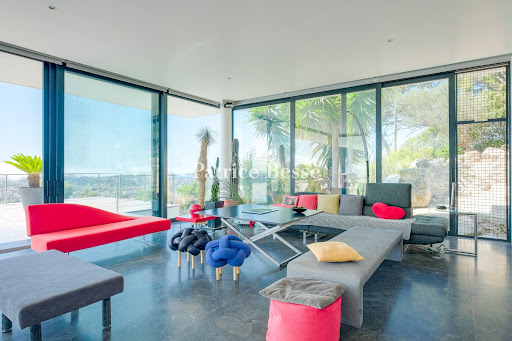
A California-style house with panoramic sea views set in 4,000 m² of grounds in the hills above Toulon. The property is located halfway up a sloping cul-de-sac, with an automated gate marking the main entrance. There are two secondary entrances on the south and north sides of the property. Once through the gate, five parking spaces are available, either directly in the large basement or outdoors. The house has three levels, extended by terraces. Each storey is set back from the one below: almost all the walls are of glass, with sliding glass doors and some concrete walls painted white. The flat roofs are either painted white and covered with gravel or form terraces, the largest of these extending across the first level, which includes a swimming pool. The roof of the second level is entirely covered with solar panels, for complete self-sufficiency in electricity.
…By Patrice Besse


An early-20th-century Mediterranean villa to be renovated in a commanding position with a sea view, nestled in 4,200m² of tree-dotted grounds in the town of La Croix-Valmer. From the town centre of La Croix-Valmer, a small secondary road snakes between grand villas – tokens of an era when tourism revealed one of the most beautiful spots on the French Riviera. Beyond a bend, a discreet tree-lined track leads up to a large gate – the property’s main entrance. Once you have gone through this gate, a drive takes you to a parking area in the shade of age-old trees and to a garage in the eastern section of the house’s semibasement. The edifice faces south-west. It stands on the edge of the property, in the plot’s north-west corner. This frees up a vast area of the garden at a lower level. The facade is coated with white rendering and it has a granite base course. It forms an L shape with a left-hand gable wall that protrudes slightly beneath a roof of green tiles. There is a raised ground floor and a first floor. This facade is punctuated with quoins in a notched pattern and windows of varied shapes set in surrounds with mouldings that have different motifs. On the top level, there is a balcony of finely carved wood that offers an unrivalled sea view and vistas of the lush surroundings. A small flight of steps leads up to the porch of the main entrance door, which takes you into the raised ground floor. A lacquered canopy crowns the porch, which has a glazed wall with tinted edges and wooden framing that recalls the other timber embellishments of the elevations and roofing and that give the edifice stylistic coherence. The eaves are supported with solid braces of wood crafted into curves and painted in the same yellow tone as the window frames, balustrades and shutters. The rear of the house is separated from the front by a small inner court that brings natural light into the adjoining rooms. The rear section is lower in height than the front section. Different roofs of red tiles are juxtaposed upon it. One of them crowns a polygonal tower. This rear section gives the house depth and mostly contains service rooms.
…By Patrice Besse


A unique, centuries-old chateau and its terraced garden on the edge of a typical Provence village set in a regional nature park . A raised driveway bordered by hedges leads from the village to the estate. A wide wrought iron gate, framed by two masonry pilasters and topped by an interlaced decorative motif, marks the entrance to the property. The terrace in the upper part of the estate reveals a succession of buildings and the long eastern facade, as well magnificent views towards the valley in the distance. The scent of boxwood and roses wafts across the landscape, while the sound of trickling water can be heard in the moat below. Built in the 17th century and enlarged in the 18th century following the main stylistic principles of classical Provence architecture, the building was extensively altered in the 19th century with the addition of a corner tower and an aviary, giving it its current castle-like appearance. The various parts of the edifice, which have survived the centuries, thus present a unique appearance, somewhere between a bastide (Provence farmhouse) and a chateau. The complex comprises four different sections. Three of them have juxtaposed east-facing elevations with regular, symmetrical windows, while the fourth is set back behind its stone-paved courtyard and blue-painted wrought-iron gate and railings. The western facades have fewer and more discreet windows than the other elevations and are all aligned along a little-used village street to the rear of the buildings. The different materials used for the facades and roofs - coursed rubble masonry, brick, slate and terracotta - reflect the construction periods of the various buildings and extensions. The buildings are bordered by several terraced garden areas, benefiting from a water source in the village that is reputed to be inexhaustible. The upper level, at the foot of the château, comprises a rose garden with its pond to the south, a terrace with its water fountain and an impressive chestnut tree in the centre and, to the north, a formal French-style garden with its parterre of pruned box and a series of eleven vaulted ponds, fed by the spring and releasing the overflow of water at the bottom of the estate. A large field at the bottom of the estate provides a distant view of the valley overlooked by the chateau.
…By Patrice Besse


A renovated house with a swimming pool and sea views on 2 hectares of land in Provence, opposite the Îles d’Or islands and at the foot of the Massif des Maures mountains, in a dominant position. The property’s gates appear after a bend on a road that rises up the hillsides. They open onto a driveway of approximately 100 metres, lined by evergreen oaks, that leads up to the property and its grounds of more than 2 hectares. The house stands on a flat outcrop of more than 3,300 m². Facing the drive is the eastern façade, to the side of which there is parking space for two vehicles. Behind a dry-stone gateway, there is a shady inner courtyard through which the swimming pool can be reached by going round the house. This three-storey, 225-m² house was built in 1968 and is made up of a succession of living spaces bathed in light. The buildings are set around a half-enclosed courtyard to the north, which is an ideal place of refuge in the summer thanks to the shade and coolness it provides. The upper floor can be reached from the inside but also the outside, where a stone staircase with a wrought-iron guard-rail adorned with spiral patterns provides the potential for independent access. The gable roof is made of half-round tiles and boasts a triple Génoise corbel. Along with the pink, ochre coloured rendering of the façades and the bullseye windows, this gives the building a typical Provence feel. A modern and fluid touch in the main living rooms is provided by the large full-length windows. To the south, the property boasts a vast expanse of wooded terraces stretching over 1.5 hectares, which is home to several horses and their paddocks, shelter and dressage arena. Over a landscape of woods and vineyards, the property offers sweeping views of the Mediterranean Sea in the distance.
…By Patrice Besse


The advertiser did not provide an english description for this listing.
…By Patrice Besse


On the heights of Cavalaire, a villa with building potential, its landscaped garden of 1,500 m² and its swimming pool, 900 m from the sea. From Le Rayol or La Croix-Valmer, the coastal road accesses the residential area of Parc de Cavalaire, where the property is located. Built on one of the town's hills, the house, at the end of a cul-de-sac, is about 900 m from the sea, in a preserved environment free from noise and visual nuisances. A paved path leads to two parking spaces that run alongside the house on one side. Raised by one story on its half and extending to nearly 200 m², the villa was built in 1983 and then enlarged the following year. In Provençal style, with its understated facades of stone blocks covered with ochre plaster, its asymmetrical straight windows, its two-pitched tiled roof, and its two-row cornice, the house was constructed in a dominant position on the plot. On three sides, the house is extended by a terrace, one of which, to the west, is covered by a trellis set up as a dining area for summer. In the foreground, backed by a dry-stone terrace, a rectangular swimming pool and its large semi-circular beach create a beautiful view of the surrounding hills. The garden, about 1,500 m², well-maintained and lush, is rich in a remarkable diversity of plants dominated by a phoenix palm, while the sea comes into view through the vegetation on the horizon. The villa has a living room, a dining room, a kitchen, an office, five bedrooms, and two shower rooms. It is adjoined by an old garage converted into an independent studio of nearly 20 m², ideal for accommodating family or friends. The whole enjoys a calm and green setting typical of a seaside residence.This description has been automatically translated from French.
…By Patrice Besse


A spectacular residence, dating from the 16th, 18th & 20th centuries, and its farm in a verdant, 6.5-ha setting at the foot of the Luberon mountains. The construction of this old farm, comprising three separate buildings, took place over almost four hundred years, between the 16th and 20th centuries. The gateway stands alongside a narrow lane going to the village. It gives access to a driveway, bordered with pine trees, that leads to the house. Parklands, on either side, are planted with Mediterranean vegetation. The driveway provides a view of the main, one-storey building, reflecting vibrant Mediterranean colours. A stone tower spans three levels on the west facade. A square tower, set back from the main facade on the east side, features a roof terrace, looking out over the rear parklands, with the mountain range in the distance. A small corner tower flanks the south facade of the construction. The housing continues with the stone farmhouse spanning a garden level and a partial upstairs. At the end of this building are a swimming pool and its green open spaces laid to lawn. The rear facade of the property looks out over romantic, wooded parklands, a vegetable garden and an old oval ornamental pool. A dual flight of steps goes up to the south terrace, bordered by a balustrade.
…By Patrice Besse


A former 18th century farmhouse which has been renovated and extended over the years in the hills of Green Provence, set in 1 hectare of grounds planted with lush vegetation. . After turning off a departmental road, the property is accessed via a roughly 100-metre-long dirt track, in the middle of the vines. A low wooden gate at the rear of the house to the north opens onto a vast, flat area where several vehicles can be parked, and where a remarkable oak tree which is over 400 years old takes pride of place. Behind it, a wooded area slopes down to the stream that runs along the western edge of the property. More than 1 hectare of dense vegetation surrounds the property, which is entirely enclosed, giving it the utmost privacy. Mainly facing south, the original residence was built in the early 18th century and underwent several extensions during the 19th and 20th centuries. The two-storey building has a double-pitched, canal-tiled roof edged with a double row of spandrels. The façades are rendered in an ochre colour and have large-paned windows and white wooden shutters. A veranda with white wrought-iron frames and a wisteria canopy was added in the 20th century and extends the west side of the main façade. Several delicately landscaped outdoor areas stretch out in front of and on either side of the building. A gravelled terrace with a fountain, planted with ancient plane trees, mulberry trees and a Canadian maple, runs along the front of the building and leads down a few steps to the pool area further down on the west side. On the other side of the terrace to the east, there is a stone basin above vegetable patches bordered by low drystone walls. Further down, there is a grassy area planted with olive trees before the orchard where several varieties of fruit trees are planted.
…By Patrice Besse


The advertiser did not provide an english description for this listing.
…By Patrice Besse


A late 19th century Belle Époque villa with sea views and 4 000 m² of grounds, 5 minutes from the centre of Saint-Raphaël . The property is set in large, gently sloping grounds planted with trees, structured by several terraces and bordered by ancient dry stone walls. This spacious late 19th-century bourgeois residence sits at the top of the plot, where it enjoys a south-facing view over the grounds, with the seafront as a backdrop. Built on a base of exposed ashlar, the building has four storeys with rendered façades, ashlar quoins, window frames and balconies. The roof has interlocking tiles and four slopes topped with chimney stacks. The former main entrance, a large gate at the bottom of the property leads to a carport in need of renovation. The way up to the house was via a wide, curved stone staircase looking over a wooded area. A second entrance, which was originally a service entrance, is now more useful as it is close to the building.
…By Patrice Besse


The advertiser did not provide an english description for this listing.
…By Patrice Besse


An imposing 900 m² house in an 8-hectare estate, interspersed with olive trees and vines in Provence, to the west of Toulon and 20 minutes from the shores of the Var department . Behind a wrought iron gate framed by stone pillars, a winding, shady cobbled driveway stretches almost 100 metres. It winds through vineyards and olive groves, then gently climbs the curves of the land to the house, which is hidden from view and blended in perfectly with the landscape. The estate covers more than 8 hectares of farmland. The house, right in the heart of this natural environment, has a total living area of around 900 m². Built in the mid-19th century, the original building faces north-south and spans around 300 m² over two storeys. Its stone façades and gable roof are typical of local rural architecture. An extension, which blends in coherently with the original building, was added around 15 years ago, perpendicularly, to the west. Facing east-west, it forms a T-shape with the old wing, and is two storeys high as well. Although designed as two independent entities, the two buildings could easily be connected to create a fluid interior flow. To the north-east, the paved driveway continues on to the various outbuildings: garages, farm buildings and storage areas. Below, on the south side, a vast 18 x 7 m swimming pool is lined with travertine decking and backed by a pool house. A little further away, to the west of the house, an equestrian structure comprising a few loose stalls and a lunge ring in need of renovation is a reminder of the estate's agricultural vocation.
…By Patrice Besse


The advertiser did not provide an english description for this listing.
…By Patrice Besse


The advertiser did not provide an english description for this listing.
…By Patrice Besse


The “Mas de la Brune”, a listed, Renaissance-style gem, its 4 ha of parklands and its gardens at the foot of the Alpilles mountains in Eygalières. At the end of a row of two-hundred-year-old horse chestnut trees, three interconnected constructions comprise the buildings on this predominantly wooded, 4-ha property. The first is the Renaissance-style manor house, known as the “Mas de la Brune”, constructed in 1572; the only building of this type, standing in the middle of the land, rising up like a nave, proudly showing visitors the prow of its watch-turret. Directly adjoining the manor, a more recent construction dating from the 18th century stands in the shade of a three-hundred-year-old lime tree. This building once housed the staff accommodation. And lastly, on the east side, where a perimeter wall no doubt once existed, a rehabilitated farmhouse is separated from the manor by a row of cypress trees. Opening on to a vast courtyard that extends behind the French formal garden, it acts as a link with the rest of the parklands, where the permanent singing of the precious water, coming down from the Alpilles Mountains via the canal of the same name, can be heard. The French Historic Monument listing, dating from the 9 August 1924, applies solely to the “Mas de la Brune”, already showing on Cassini’s 18th century map under the name of “Grand Mas”. Some say it was constructed for the consul Pierre-Bruno-Isnard, who gave it the feminine version of his surname, whilst others maintain it was for an alchemist, whose name is long forgotten. In both cases, this outstanding building, entirely constructed from Baux stone, was probably built by master mason, Gaston-Flayelle, native of the Vivarais region, who also designed the “Hôtel de Manville” in Les-Baux-de-Provence. The size of the manor house, its biblical paraphrases sculpted on the façade, like a big open book, and including the secret number of steps of its spiral stairway tend to reinforce the hypothesis of an alchemist’s home. A spacious tiled swimming pool, cleverly concealed from onlookers in a copse of laurel bushes, has been installed a good distance from the main house. And lastly, a carpark, out of sight of the manor but able to take ten or so cars, has been laid out in the shade of mulberry plane trees.
…By Patrice Besse


A 750-m² renovated villa, owned by the same family for the past two centuries, with 4.5 hectares of farmland, a swimming pool and vast grounds, near Toulon. The property, facing north-south, covers an immense rectangular-shaped area of 4.5 hectares. Accessible from the B road to the south via the main entrance, followed by an olive tree-lined lane of nearly 200 metres, the property also has a second, more discreet entrance, located on its northern side and accessible via a small public road, while two wooded areas can also be found on the property: one to the north, near the buildings and, the other, to the southwest. As for the property, currently used for weddings and seminars, it would also be ideal, after some minimal modifications, as a family residence, a bed and breakfast or charming holiday accommodations. The edifice, built in 1730 and then meticulously renovated in 2012, displays the classical appearance of a three-storey construction, cadenced by five vertical rows of windows and topped with a hipped roof. Abutting the northwest side of the villa is a 17th-century building, also renovated, which includes a professional kitchen on its garden level and a caretaker’s flat upstairs. As for the villa, it is preceded by a glass entrance porch, which opens onto an entrance hall and includes two living rooms on its garden level, three other sitting rooms, a nuptial suite and a study on the first floor, while the occupant’s private living quarters, with four bedrooms and accessible via an independent staircase, are on the second floor. As for its exterior, a large gravel patio runs along the length of the façade and is decorated with a circular ornamental pond, while the swimming pool area is located below to the east of the central drive and, given its size, makes it possible to regularly host wedding receptions under tents that are set up during the summer months. In addition, the two side sitting rooms and the office on the first floor could also be reconverted into bedrooms with lavatories for a total of ten bedrooms in all, including the caretaker's flat. Lastly, a number of outbuildings are located in the property’s wooded section extending to the north of the villa, such as: a garage, storage rooms, a vaulted cellar as well as a giant rainwater tank and an old well.
…By Patrice Besse


A more than 140-hectare hunting estate with an 18th-century Provence farmhouse, in the Alpes de Haute-Provence area. The estate can be reached via a discrete tarmacked track that winds through the greenery to the entrance gate. Beyond the gate, the grounds of the vast, entirely fenced, 138-hectare estate, fully preserved from any hustle and bustle, are divided into two separate parts. An old edifice made from local stone and built in the 18th century can only be seen from inside the estate, tucked away in the centre of the first part of the grounds. The typical Provence farmhouse stands in the middle of meadows overlooking the valley. It is set around a central courtyard and includes several independent homes. There is a summer kitchen that is dominated by a swimming pool surrounded by a covered patio and a summer lounge, boasting a panoramic view over the Alpine relief. A second entrance on the Luberon side of the property can be reached by carefully maintained tracks. They also lead to almost 3 hectares of truffle oak trees whose produce is farmed and sold, as well as two lakes. As for the outbuildings, a large edifice contains several garages, a workshop and storage space for agricultural equipment. A well-structured kennel area is made up of twenty boxes, all of which are lit and boast a water supply. The water supply for the estate, which has become a crucial issue in southern France, is guaranteed by a 105-metre-deep borehole fitted with a submersible pump in 2020 that fills a 75-m³ water reserve equipped with a UV treatment system. Several springs and a traditional Provence stone well further enable the property to be self-sufficient in terms of water. The estate is connected to the electricity as well as telephone networks and also boasts potential for production of photovoltaic solar energy.
…By Patrice Besse


A 20th-century Mediterranean villa with a sea view and over 5,000m² of grounds, nestled near Toulon in south-east France. An electric metal gate leads into the property. A winding driveway, lined with stone walls and vegetation, stretches 150 metres. This drive leads to a gravelled court where two age-old olive trees tower. The dwelling has a ground floor, a first floor and a second floor in the roof space. It offers a liveable floor area that is currently around 250m². A basement adds 130m² to the floor area. The villa is classical in style. It faces north and south and is made of rubble stone, coated with pale ochre rendering. Many openings punctuate the facade, with large-paned windows and glazed doors fitted with shutters painted green. The edifice is crowned with a gable roof of barrel tiles, underlined with a double-row génoise cornice. The window surrounds and roof stringcourse are white, bringing out the ochre tone of the rendering and all the other colours of the whole. On the south side, there is a terrace with a court with olive trees. Here you can admire a view of Toulon’s natural harbour and the sea. On the west side, there is a second terrace. It offers a view of the surrounding hills and the grounds, which are terraced with dry-stone retaining walls.
…By Patrice Besse


A large architect-designed villa in a site overlooking La Seyne-sur-Mer, with a roof terrace and swimming pool, in 2,400 m² of tree-lined grounds. A tarmacked lane leads to the entrance of the property whose double-leaf solid metal gates decorated with wrought-iron arabesques are electrically powered. A stone-paved driveway leads up to the house’s porch to the left and a large garage straight ahead. The villa was built in 1967 and boasts living space of approximately 370 m². It is rectangular in shape and has three storeys that embrace the terraced lie of the land. The upper level is made up of vast roof terrace with more than 150 m² of space and views of the sea. The walls of the façades are rendered in white and are dotted with large aluminium windows as well as French windows, fitted with electric roller blinds and black wrought-iron grating for the openings on the garden level. A very large glass-paned veranda adorns the southern façade, while a triangular awning protects the entrance door. There is a gigantic lounge bathed in the light that flows through the veranda on the garden level, next to a kitchen and master bedroom with en suite facilities, while four other bedrooms and related rooms are located on the lower level, all opening onto patios that lead into the garden. The grounds are made up of several terraces planted with cork oak, pine, palm, olive and fig trees. The largest terraces play host to an outside dining space with an outside oven on one, a swimming pool with decking and pool-house on another and, lastly, a relaxation area, flower beds and a fishpond for the others.
…By Patrice Besse


The advertiser did not provide an english description for this listing.
…By Patrice Besse
'%20stroke='%23DDAA3A'%20stroke-width='1.909'%20stroke-linecap='square'%20stroke-linejoin='bevel'/%3e%3c/svg%3e)
Receive by email any new listing that may match your search criteria
Your criteria :
By validating this form, you accept the general conditions of use of Le Figaro Properties.
These agencies offer a selection of luxury properties vente in Provence-Alpes-Côte d'Azur. Feel free to contact them for personalized assistance.